
When we arrived at the Jorge Chavez International Airport the following morning – after an evening of roaming around the historic center of Lima – I finally revealed to Susie the sacrifice that I had to make at the start of the journey to South America.
“I need to check with the ticket agent to make sure our tickets for our return flight home are in their computer system,” I said to Susie as we made our way through the renovated and modernized airport. Tourism in Peru had increased dramatically in recent years, and it would continue to grow with the designation of Machu Picchu as one of the modern Seven Wonders of the World.
“Why would the tickets not be in their system if you already paid for them?” asked Susie with a puzzled look on her face.
“I wasn’t going to tell you what happened in San Francisco at the Continental ticket counter,” I confessed. “But they told me your ticket wasn’t valid unless you flew both ways with me. A round-trip ticket means you have to be on both flights.”
“What?” said Susie, suddenly concerned about her situation. “You mean you don’t have a valid ticket for me?”
“I do have a ticket for you,” I replied, showing her the one-way ticket that I had bought. “I had to pay the price of a one-way ticket from Lima to San Francisco. It was my mistake, and I should have checked with Continental. As it turned out, it was a costly sacrifice or offering that I had to make to the sky gods.”
Susie was relieved to know that she had a valid ticket for her return flight, and the Peruvian ticket agent verified it for us. We were in their computer system. Now all we had to do was board the LAN Airlines flight to La Paz, Bolivia.
Our flight over Peru and Bolivia was uneventful. Susie had the window seat, and we were flying too high to see the landscape below. The five-and-a-half hours flight to La Paz had a short stop at Santa Cruz de la Sierra (“Holy Cross of the Mountain Range”). When we arrived in Nuestra Senora de La Paz (“Our Lady of Peace”) – its original name, established by the Spanish in 1548 – the first thing we felt was the thin air and lack of breath. We were at the highest capital city in the world at an elevation of 3,660 meters (11,942 feet) above sea level.
The second thing we felt was the shock of the unexpected surprise waiting for us at customs. We thought we would pass through customs as simply as we had done in Colombia, Ecuador, and Peru, showing our passport and paying a small entrance fee. However, the customs official told us that US citizens needed an entry visa to enter Bolivia as a tourist.
“The tourist visa costs $135 per person,” we were told by the customs official.
“I don’t have that much money on me,” I told the immigration authority.
“Do you have a credit card?” asked the official.
“Yes, I do,” I answered. He took me to an ATM machine where I withdrew the required amount in US dollars for both of our visas.
“Why do you require an entry visa when Colombia, Ecuador, and Peru don’t require one?” asked Susie after the customs official finalized the entry visas and placed them in our passports.
“The United States requires Bolivians to get a visa when they go to your country, so Bolivia requires a visa for US citizens coming to our country,” explained the customs official. Later, I found out that the US made the visa a requirement to track people who visit and stay and, of course, the terrorist threat. So certain countries instituted a reciprocity policy to require other countries to make their citizens also obtain a visa. Plus, it seemed like a way to cover the costs of running the customs administration.
When we arrived at the Loki hostel, a renovated colonial hotel named after the trickster god of mischief, we felt the need to go shopping immediately for warmer clothes, especially for hats to keep our heads warm. We found the local markets and shops, and we found the 100% alpaca wool hats with the warm earflaps that we saw the antiplano (high plains) Aymara people wear. Susie’s knit alpaca had horizontal stripes with different colors and geometric shapes. My reversible Bolivian chullo (from Aymara ch’ullu) hat had earth-colored tones of brown, black, and beige with a wave-like geometric design on one side, and a row of brown alpacas and Andean motifs on the other side. Now we could keep our heads warm in local style.
I couldn’t sleep that night. The music in the bar downstairs was so loud that the walls shook from the deep vibrations. Also, Susie had stayed out late at the internet café, chatting with friends online, cruising the internet, making comments on Facebook, and sending emails to her friends. I took only an hour at the crowded internet café to post a few pictures and update the blog that I was keeping of my travels. So I kept thinking of my daughter walking home in a city of about one million people in the middle of the night, and I kept looking out the window on a dark narrow street where the crowds had dwindled to a few stragglers. It occurred to me that fathers worried about the safety of their daughters just as much as mothers did. Eventually, when Susie finally knocked on the door, she was surprised that I was worried about her well-being. After all, as she said, “I’m a grown woman, and I can take care of myself.”
The following morning, we were picked up at our hostel by the Kanoo Tours travel agency. I had booked the tour to the Tiwanaku (also spelled Tiahuanaco) pre-Inca ruins from home. The Cordillera Real in the east rose like a range of white light as the tour bus traveled about 72 km (44 miles) west of La Paz.
A large painting of the former glory of the city of Tiwanaku loomed in my mind as we followed our guide through the museum at the UNESCO World Heritage Site. There was something mysterious about the appearance and subsequent disappearance of a civilization that was considered to be the mother of Andean civilizations. This was the place where the creator-god Viracocha had appeared to create a new race of human beings.

The sculptured stone images (or idols) at the museum spoke of a people whose wisdom and knowledge was transmitted through carved inscriptions and geometric designs on megalithic monuments. I had seen similar sculptured stone statues in Mexico, Guatemala (Tikal), Honduras (Copan), and at San Agustin archaeological site in Colombia. I had seen the glorious temple-pyramids of the sun and the moon at Teotihuacan (“birthplace of the gods”), and I had entered the Temple of Quetzalcoatl (“the feathered serpent”). Tiahaunaco (“city of the gods”), whose Aymara name was Taypikala (“the stone in the center”), was another one of those mythic sacred places where the story of the gods, the center of the world (axis mundi), and the genesis of humanity was intertwined in a vortex of energy that united the heavens and the earth.
A larger, newer museum next to the older museum housed the famous 7.3 meters (24 feet) Bennett Monolith, which was discovered by Wendell C. Bennett in 1932. It was moved to the city of La Paz a year later. However, it made a triumphant return to its place of origin in Tiwanaku in 2002. Called the Pachamama monolith by the Aymara people of Bolivia, the anthropomorphic stela’s iconography portrayed an agricultural calendar, a staff god, and various symbolic animals (fish, condors, pumas, and llamas). It was Viracocha at the center of the Andean universe – the stela was found at the center of the Semi-subterranean Temple – and it was the axis mundi or tree of life that grew out of Mother Earth (Pachamama).
At the Akapana temple-pyramid, our guide stopped our group at the partially reconstructed western base to give us a short introduction to our tour of the ancient archaeological site:
“Ancient stories tell of a time when the creator-god Kon Tiki Viracocha brought into existence the earth and the heavens. This divine being created a race of gigantic human beings. Some people say that these giants built the city of Tiwanaku, for they could move boulders and rocks easily. Later, the giants angered Viracocha, so they were turned to stone. Then he sent a flood as a Pachacuti or earth changing event to start a new world and a new race of human beings. Afterwards, the cosmic creator rose from the depths of Lake Titicaca and stepped on the island of Titicaca (now called Isla del Sol or Island of the Sun), where he commanded the sun, moon, and stars to appear and move in their orbits. Then he came here to Tiwanaku to set in stone the images of the nations that would repopulate the earth. And so the people of the various nations were called to emerge from the sacred landscape of springs, rivers, caves, trees, and mountains.
“We stand here at Tiwanaku where the story of humanity’s emergence into this world took place. We call it the Pacarina, the sacred place of humanity’s genesis. The Akapana temple-pyramid (or pyramid of the sun), the Semi-subterranean temple (or place of the images of the nations), the Kalasasaya temple (or the place of standing stones), and Puma Punku (the door of the puma) – these four sacred huacas (or shrines) symbolize the creator Viracocha’s cosmic handiwork.
“At present, the Akapana temple mountain is in the process of restoration, but as you can see, not much has been accomplished, yet. To use adobe bricks is not what UNESCO wants, and to get stones from distant quarries, like the original builders did, is a difficult task. So you can see just a few sections, such as the section showing seven terraces, and the stones at the base of the pyramid. You saw Aymara people near the museum – those are the workers that now have paid jobs excavating, refurbishing, and reconstructing the ancient ceremonial city of Tiwanaku.
“You have to remember that the old city is mostly buried beneath the ruins that you see. Most of the original stones were taken from the site to build bridges, highways, churches, railroad construction, and, of course, personal homes. There was a lot of looting and amateur excavations. About 90% of Tiwanaku has disappeared. The truncated pyramid of Akapana that we will now climb is, as you can see, only a mound of rock and earth. What it used to be you have to use your imagination or look at artistic representations of what it probably looked like.”

As we climbed the steps to the top, I tried to imagine the seven-tiered pyramid. I recalled the painting with the Andean cross in the center at the top of the temple-pyramid. My mind wandered as the air got thinner at the high altitude of 3,842 meters (12,605 feet) above sea level, and my breathing became labored. I reached into my fanny pack and took out a coca candy that I had bought at a shop in La Paz. The altitude sickness feeling in the stomach and the dizziness in the head subsided. I thought of what the guide said, about the story of Viracocha and the race of giants. If the giants had anything to do with building Tiwanaku, then the biblical statement would be proven to be true: “There were giants on the earth in those days.” (Genesis 6:4) After all, the earth had been inhabited by various races of human beings for millions of years, and most of the western worldview saw humans living in the western hemisphere only during the past ten to forty thousand years.
Time seemed to stand still when I reached the top of the Akapana pyramid. Climbing past the seven levels of mythic time (and consciousness) brought me to a sacred space where the summit of the mountain revealed everything around the center. I was at – what the Aymara called – the place Taypikala, “the stone in the center,” the place of the eternal now where creation is an ongoing process and the solar-lunar energies merge at the Andean cross (the Chakana of the Andean cosmology and its three worlds). In the Aymara worldview, this Andean cross with its three levels had a core meaning of life as an essence called Pacha: Alaxpacha, the Pacha of above, of light, the celestial, the gods; Manqapacha, the Pacha of below, of darkness, the underworld, the ancestors; and Akapacha, the Pacha of the present moment, of creatures and humans living on, and interacting with, Mother Earth (Pachamama).
“Here you can see the natural surroundings that the ancient people saw,” said our guide when we were gathered together at the top of the Akapana pyramid. “To the east you can see the three peaks of Mount Illimani, where the rising sun would establish the solar path that would traverse across the east-west axis that Tiwanaku is oriented to. To the west you can see Lake Titicaca, where the setting sun would disappear into the place of origin. So the people built this temple-pyramid to represent the mountains, from where water, life, fertility, and abundance come, and the lake, from where the origins of creation, and the sun, moon, and stars come. This is the sacred mountain, and the sunken court you see in the middle had a perfect square superimposed on an equal-armed cross: signifying the Andean cross of the four directions and the seasons; the cosmic Southern Cross; the twelve corners (or months) of the calendar year; the three steps or levels of upper, middle, and lower worlds; the three energies represented by the condor, the puma, and the snake; and in the center, a portal leading to the center of the world. To the Aymara people, the center was here at Tiwanaku; to the Incas, the center was at Cuzco. You will find the Andean cross or Chakana everywhere. It is a powerful symbol or emblem with many meanings.
“Another aspect of this sacred mountain and this sunken court is the architecture and engineering that created a system of subterranean canals that drained the water that collected in the sunken court. The rain water collected in the sunken court, then it would flow underground and surface on the stepped terrace; and it would continue to repeat the underground and surface flow on each terrace until it reached the bottom. Then it would drain through an underground system into the Tiahuanaco River, which emptied into Lake Titicaca. So here we have in this sacred mountain of Akapana a man-made replica of the physical mountain, which to the Aymara was a spiritual being or Apu. The mountain was the source of water that nourished the people and the fields, and the Akapana imitated the pattern of nature as the water that flowed from above to below, from the heavens to the earth. Man and nature were united on this sacred mountain, and the ceremonies performed here were performed in recognition of man’s dependence on the water of life and on Mother Nature (Pachamama).”
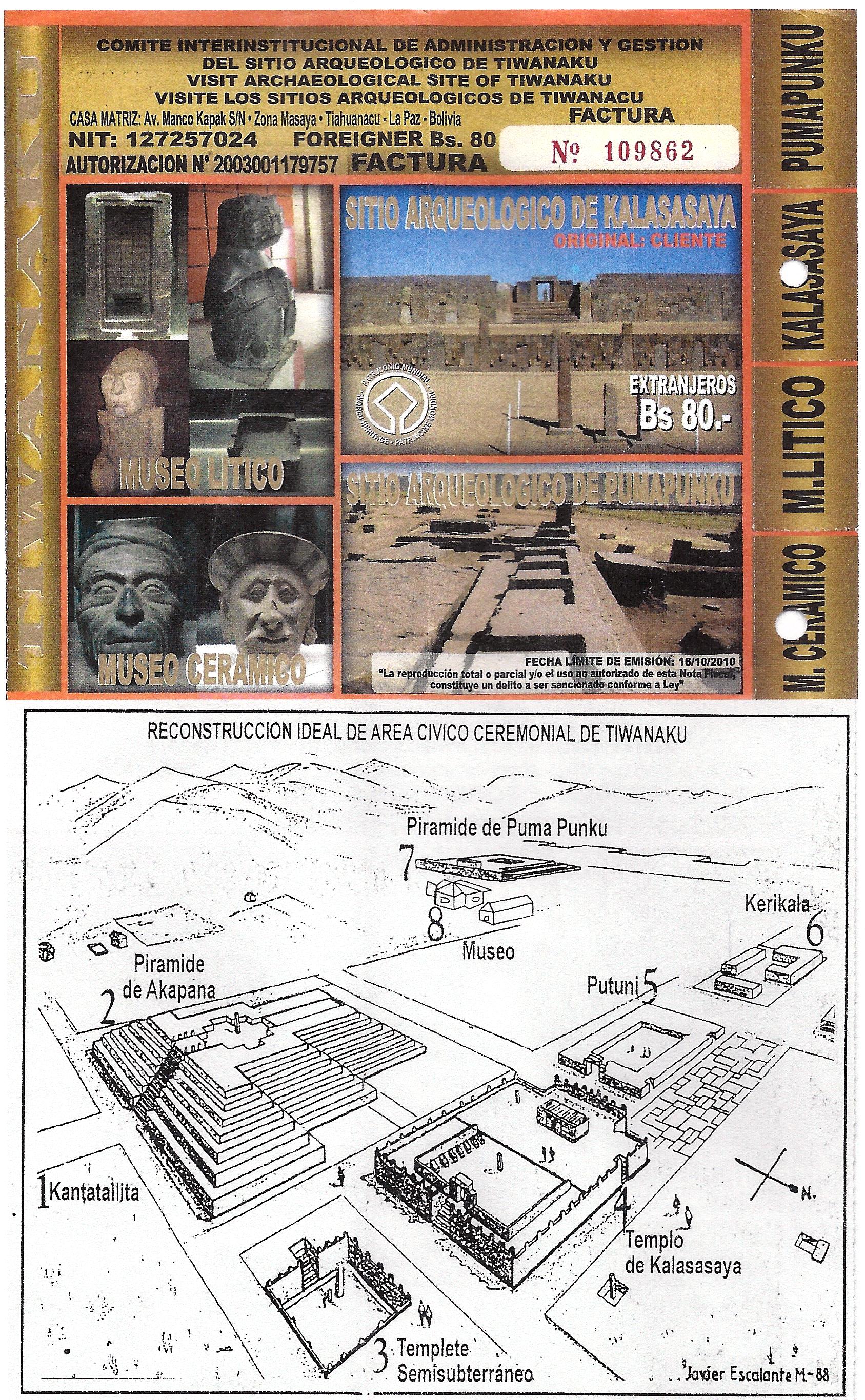
When we came down from the sacred mountain, it dawned on me – from the diagram of the site on the back of the entrance ticket – that the Akapana was structurally designed to resemble half of an Andean cross. In other words, it brought down to earth the three levels of the Andean cosmos: the upper, middle, and lower (or Alaxpacha, Akapacha, and Manqapacha).
Descending into the Semi-subterranean temple was like descending into the underworld of the ancestors. We went down the steps to a depth of about 2 meters (6.5 feet) into what felt like another world. Intricately carved stone faces jutted out of the red sandstone walls.
“There are 175 human heads that project from square or rectangular holes in the wall,” said our guide. “Some archaeologists assumed that since these heads represented the souls of Aymara ancestors, there must have been religious ceremonies of remembrance of the dead held here. However, it is also probable that the ceremony was a political-religious event celebrating the unity of the different ethnic groups or nations of the Andean world. After all, the Tiwanaku civilization incorporated many tribes and nations of the antiplano and adjacent areas into its empire. And also, since this was the place where Viracocha set in stone the images of the people from various nations that repopulated the earth after the flood, the faces you see are the ceremonial representations of those images.”
Looking at the stone faces that projected from the stone wall gave me the impression that I was witnessing the creation of humanity by Viracocha. I visualized the mythic time of the eternal now as alive and vibrant with the presence of ancestral beings, whose spirit permeated the stone faces. The stone faces were speaking of a distant, yet ever-present, time. Their life essence flowed in the veins of the Andean people, and the memory of their existence was immortalized for the modern tourist to see.
“Remember that the Bennett (or Pachamama) monolith stood at the center of this temple,” added the guide as he guided us to the three stone stela standing in the center. “Kon Tiki Viracocha, the male-female energies of the creator, and the two servants who assisted the creator in the creative act of calling out the tribes and nations of the human race to come into existence are represented by the four monoliths that stood here. Three are here, and the Pachamama monolith is inside a special place built for her.”
I came up close to inspect the taller red sandstone statue. It had a design on it that I instantly recognized: the dragon or serpent of wisdom. This was a tell-tale sign that the city was the center of the serpent or primal dragon culture, the temple of the mythic Quetzalcoatl (“the feathered serpent”). The ancient wisdom of the kundalini (serpent power) within the energy centers of man’s spinal system and the energy centers within the body of the planet’s spinal system (the Andes) was taught here by the shaman-priests who followed the axiom: “Be wise as serpents.” I also realized that the Semi-Subterranean temple, as a representation of the underworld (or inner world), had the serpent as its totem animal in the Andean cosmos. Last, but not least, the dragon or serpent was a universal symbol of our galaxy, the Milky Way.
As I walked away from the statue, I glanced at its frontal view and noticed the position of the hands placed on the heart and the solar plexus chakras. I had seen that position of the right hand on the heart and the left hand on the navel area at San Agustin archaeological park in Colombia. It seemed to be a symbolic representation, like other symbolic representations, that spread throughout the Andean world.

When we came up from the Semi-Subterranean temple, I wanted to get a view of the adjacent Kalasasaya temple from a position where I could see how the Pachamama monolith would have aligned with the seven-stepped stairway that led to the inner portal. When I stood on the east side of the sunken temple and looked west toward the portal that faced the rising sun, I saw a monolith in the portal (or gateway). It appeared to be facing the rising sun. I had not seen the monolith when I was standing in the underworld of the Semi-Subterranean temple. It appeared that the Pachamama monolith would be facing the monolith inside the Kalasasaya temple. It dawned on me that Pachamama (Mother Earth) was always associated with Pachacamac (Father Sky) in the Andean cosmology. So it seemed that the mother would rise up from the underworld (of the Semi-Subterranean temple) as the sun rose from the east, and she (Mother Earth) would look through the portal (gateway) of the Kalasasaya temple to see her spouse (Father Sky).

“Dad, our group is going to the next place,” said Susie, waking me up from my reverie. My mind had been submerged in an Andean world where the forces of nature took on a reality of their own. Maybe it was the high altitude or the electro-magnetic energies that swirled around me, but I noticed my mind was acutely aware of strange thought-forms all around me. It was as if I were walking in a forest and mysterious images haunted my contemplative mind.
“The Kalasasaya temple means standing stones in the Aymara language,” said our guide when I finally joined the group as they were walking to the tourist entrance on the north side of the walled enclosure. “The enclosure measures about 128 meters (420 feet) long and 119 meters (390 feet) wide. The standing sandstone pillars or columns are about 4 meters (13 feet) high. Originally, when the archaeologists came here, the place was in ruins and only the pillars were left standing. The walls you now see were reconstructed. These standing stones or pillars, as you will see when we go inside, have human figures carved on them. Some people say those human figures are the kings who ruled in Tiwanaku. Some archaeologists, like the famous Arthur Posnansky who studied the ruins for fifty years, say that this was an astronomical observatory, or as my people call it, a sun temple. The ancient priests-astronomers would study the movements of the sun, moon, and stars in the sky, and they would make critical markers that would align with the equinoxes and the solstices. The entry way that you saw at the front of this Kalasasaya temple was created so that the sun appears exactly in the center on the morning of the equinoxes. The equinoxes appeared on the twenty-second of September, the beginning of spring for the southern hemisphere, and on the twentieth of March for autumn.
“Now you will see the Ponce monolith that faces eastward and catches the light of the sun as it appears through the gateway on the mornings of the equinoxes. The Ponce monolith and the Pachamama monolith were aligned with the east-west axis of the sun’s journey. And so were the two temples, the Semi-Subterranean and Kalasasaya. The deity on the Ponce monolith, who holds the symbols of power in his hands, could have represented Tiwanaku’s ruling dynasty. On the north and south sides are chambers thought to be mausoleums for the royal mummies of deceased rulers.”
Our guide led us next to the grandest of all the city’s monuments – the Gateway of the Sun. The mysterious monolithic structure towered above us in a sphinx-like silence and posed the riddle of the ages: Who am I and what am I all about?
“This Gateway of the Sun was discovered lying face down covered with mud,” said our guide as we stared up at the undecipherable carvings on the eastern face of the monument. “It was broken in two pieces, probably because of an earthquake, and you can see the crack on the top right where it was broken and then pieced together. The gateway was a single block of hard andesite granite, weighing about ten tons. It is almost 3 meters (9.8 feet) tall and 4 meters (13 feet) long. The figure at the top represents Viracocha, the anthropomorphic spirit of the Andean cosmos, or the Aymara weather god Thunupa because of the lightning and thunder staffs he holds in his hands. Some scholars say the figure is the Staff God, the Andean world’s prime image of divinity; or the god-man, as the shamans like to call him, because he stands on the three-stepped Andean symbol of the three worlds and holds the snake-like staffs, showing he is master of the three worlds and of the serpent power.
“The archaeologist Arthur Posnansky concluded that the entire Kalasasaya temple was an almanac of carved stone, so he went about to prove that the Gateway of the Sun was a solar calendar devoted primarily to mark agricultural events and keep track of time. He saw the 30 winged attendants – or chaskis as we call them – as 30 days. You can see them as three rows of five figures on each side of the solar deity. The other nine on each side are considered unfinished. The bottom frieze has eleven solar heads, each with 24 ray-like projections to signify the 24 hours in a day. So the central solar figure would be September, the spring equinox. Then the solar being would move three months to the left to the December solstice, then to the right three months to March, the autumn equinox. The autumn equinox and the spring equinox would be aligned, top and bottom. Then the movement of the solar being would continue three months to the right to the June solstice, then back three months to the left, arriving again at the spring equinox, the place of the central solar deity.

[Later, I found a diagram of the solar calendar as Arthur Posnansky envisioned it at: http://davidpratt.info/andes2.htm ]
As I looked up at the face and imagery surrounding Viracocha, whose gaze was eternally fixed towards the rising sun in the east, I saw a complex manifestation of the invisible cosmic being as a sun-god, a staff-god, a weather (rain) deity, a shaman, a mythic Quetzalcoatl (feathered serpent), a triune condor-puma-serpent, a sacred mountain god (Apu), an array of ancestral beings – in short, everything in the visible and invisible Andean cosmos. I visualized the Gateway of the Sun standing not in its displaced northwest corner of the Kalasasaya temple, but aligned with the path of the sun at the western end of the temple. Thus, it would once again be restored to a position in which the sun would rise and shine through the eastern portal and set through the western portal (Sun Gate), making it the Intihuatana (hitching post of the sun) once again. And Pachamama-Earth Mother (Bennett monolith) and Pachacamac-Father Sky (Ponce monolith) would gaze at each other and rejoice as their children (the human race) received the energy of the new sun at the beginning of a new Pachacuti (cosmic cycle).
“Last year was the Aymara year 5517, and it was decreed by the Aymara President Evo Morales that the Aymara New Year – called Willkakuti or Return of the Sun – is now a national holiday,” concluded our guide as we started to walk away from the Gateway of the Sun monument. “He came to Tiwanaku when he was inaugurated as president in 2006, and he came here again in January of this year after he was re-elected. This year on June 21st, we will celebrate Willkakuti again, our annual winter Solstice in the Southern Hemisphere. For us, this will be the time when Father Sun returns and a new planting season begins, and we ask Pachamama (Mother Earth) for her blessings to ensure an abundant harvest. So I wish you all beforehand, Feliz Machaq Mara, or Happy New Year in Aymara.”
Our tour at Tiwanaku was over. I had only booked a half day tour, so we did not get to see the unrestored ruins and massive stones of Puma Punku (“Door of the Puma”). Nor did we get to hear about the theory that it was at one time in antiquity a great wharf and seaport on the shore of Lake Titicaca. However, I would read all about it later when I ran across Arthur Posnansky’s book called Tihuanacu: The Cradle of American Man, where he proposed an ancient origin for the city and civilization of Tiwanaku, going back to 15,000 B.C.
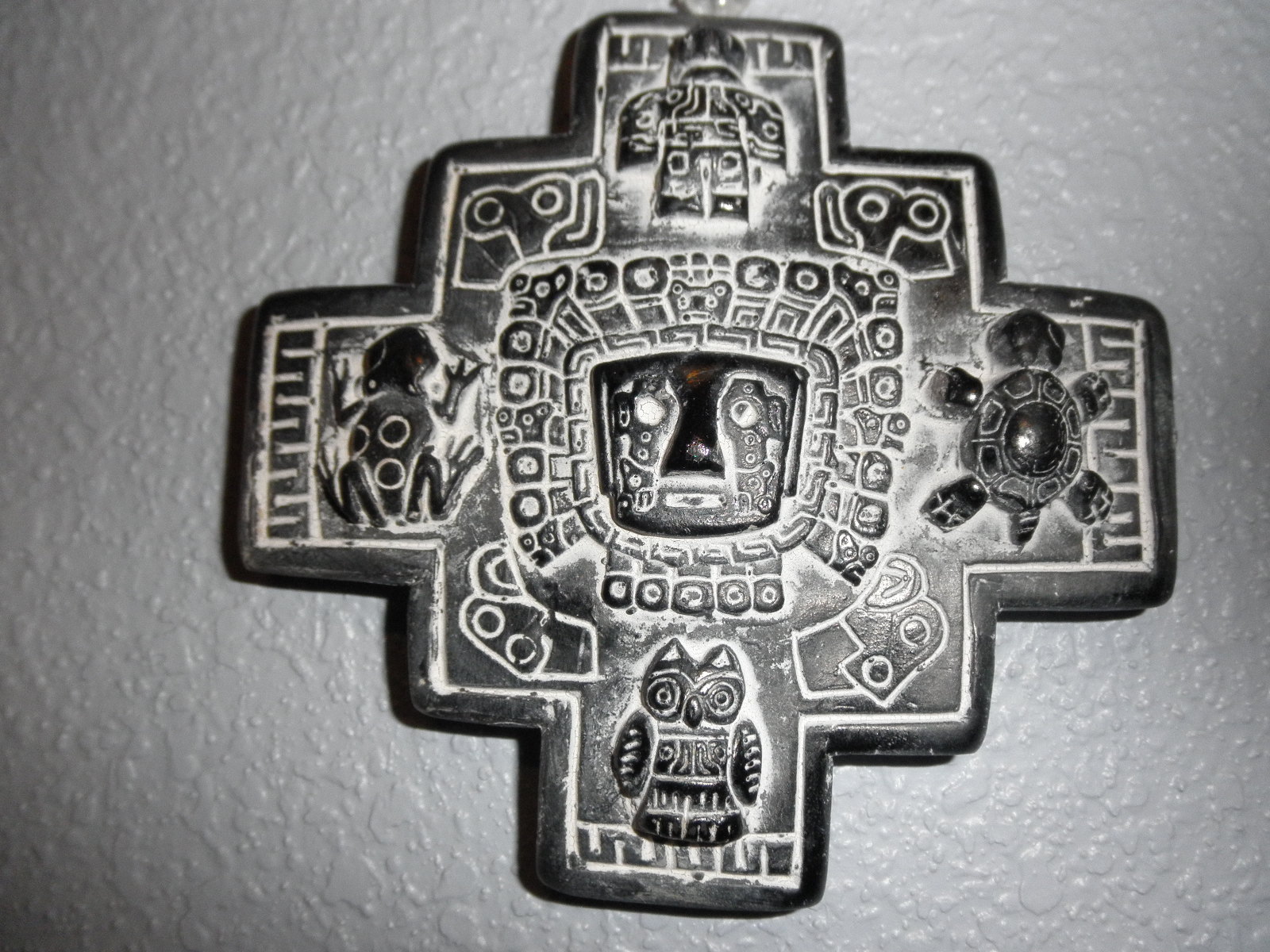
As we made our way back to the bus for our return ride to La Paz, I stopped at a souvenir table along the footpath, where a Bolivian lady in a bowler hat sold me a chakana, the Andean cross.

The chakana looked like an Aymara representation of their cosmic viewpoint: the image of Viracocha, with twenty-four solar rays (19 around his head and 5 on his beard) emanating from his anthropomorphic spirit, was at the center. Four totem animals were placed at the four cardinal directions: a condor in the north, an owl in the south, a frog in the west, and a turtle in the east.
During our short ride back to La Paz, my eyes were mesmerized by the passing scene of local indigenous people in their colorful clothing, some of them shopping for goods and others selling their wares. They were like people everywhere else in the world, with their joys and sorrows, worries and fears, moving through their environment with a purposeful hope of making it through another day, or perhaps barely surviving above a subsistence level. The drive to live and have a happy life, if at all possible, motivated the Aymara people just as much as it motivated other people in the world. They laughed and they cried, they loved and they gave birth to another generation of humans, even if they didn’t know what the future held in store for them. Somehow, Pachamama would take care of them, just like the mother carrying her child bundled up on her back in a colorful woven fabric (awayo) that I saw walking on one of the streets.

Just before we returned to La Paz, the bus driver stopped at a viewpoint to give us a panoramic perspective of the City of Peace. It was quite a sight seeing the city sitting in a bowl-shaped canyon surrounded by impressive views of the peaks of the Cordillera Real (Royal Mountain Range).

The rest of the day and evening was ours for relaxing and exploring the city. A friend of mine had lived in La Paz, and he told me I had to go to a small café in the Hotel Gloria and have a cup of the best hot chocolate in the world. David was right. The submarine-style hot chocolate was served as a cup of hot milk with a bar of dark chocolate on the side. I sank the chocolate into the hot milk, like sinking a submarine under water. The chocolate slowly melted, and the flavor that it provided to the taste buds was simply heavenly. No wonder they called chocolate from the cacao bean “food of the gods” (Theobroma cacao).
Susie had her mind set on spending time at the witches’ market (Mercado de las Brujas). She was enchanted by the various herbs, folk remedies and fascinating ingredients that were used to influence the spirits of the Aymara world. I was taken aback – almost jumped out of my skin – by the sight of the dried llama fetuses that were displayed at several shops. The lady at the shop was more disturbed than I was, for she got angry at me when I tried to take a picture of the sacred cha’llas (offerings) that were sacrificed and buried in the foundations of new constructions or businesses for good fortune and prosperity. I couldn’t understand how the earth mother Pachamama would be pleased with such a sacrifice or offering. But that was my cultural bias, and I tried to understand their point of view. After all, the idea of sacrificing an animal was as ancient as the biblical story of Cain and Abel. Nevertheless, after that encounter with the dry llama fetuses, I started to think of that shop as “the little shop of horrors.”

There were lots of other shops to look at throughout the witches’ market. There was a shop where Susie found a warm sweater for herself. She was beginning to feel that she didn’t have enough warm clothes to fight the cold at the high altitude.
I found a shop of books that interested me. I asked the sales person which book he would recommend for me, and he intuitively directed me to a book entitled The Awakening of the Puma, which had fantastic pictures of the Inka initiation path and sacred places in the Andean world where that initiation path was immortalized in monuments of stone. One of those sacred places was Tiwanaku:
“Tiwanaku represents one of the Mother cultures in Southern Peru. Lake Titikaka nurtured this society and their culture, sending them to other lands with the mission to expand the people’s consciousness of Viracocha (also spelled Wiraqocha) and its Solar science. Wiraqocha is the being of polarity who controls that which is above as well as that which is below, what is on the right and the left, that which is masculine and that which is feminine. Wiraqocha is the all-inclusive entity that represents time and space. In Tiwanaku, they represented Wiraqocha as a Solar Being, who, as well as having the fiery presence of the Serpent, manifests the stability of the Feline Totem, the Puma. But it was the Condor that was immortalized as the Sacred Bird. The Condor is considered the bird of the Sun that sees all and visits the most distant places of our terrestrial sky, until it loses itself and joins in that great unity called Wiraqocha.” (The Awakening of the Puma, by Mallku Aribalo, p. 59)
http://www.scribd.com/doc/45143093/PDF-the-Awakening-of-the-Puma-Web-Baja
Susie found a cute little Bolivian girl who was minding the shop with her mother. This girl had a bunch of little dolls for sale, and Susie wanted to buy something from the hard working girl. So she bought a little Bolivian doll from her. It was a picture worth a thousand words.

The following morning the Vicuna Tours bus picked us up at Loki hostel for our trip to Copacabana, where we would catch a boat to Isla del Sol. My mind reminisced about an event several months before my pilgrimage to South America. When I told an elderly woman from Bolivia named Matilda that I was going to Bolivia and Lake Titicaca, she acquainted me with Bolivia’s famous patron saint, the Virgin of Copacabana.
“You’ve got to see her,” said Matilda, who fished at the same reservoir as I did. “I never had a chance to see her, but I hope you do. I heard she’s very beautiful.”
“I’ll make sure to take a picture of her for you,” I promised.
Now I was heading towards the Virgin of Copacabana’s shrine, and I didn’t know what to expect. All I knew was what Matilda had told me, that she was very beautiful. I promised myself I would perform the pilgrimage to the shrine of the Lady of Copacabana for Matilda. That was the least I could do.
On the way to Copacabana, the bus stopped at a roadside inn and rest area, where I looked back towards La Paz and saw the snow-covered peaks of majestic Mount Illimani. It looked as if I could reach out and touch them – the three main peaks (one being a double peak) looked so close. The glacier-covered sacred mountain, the sentinel of La Paz and the former civilization of Tiwanaku, rose 6,438 meters (21,122 feet) into the blue sky. I was told that Mt. Illimani meant “golden eagle” in Aymara, and that it channeled “illa,” the creative life force from above, making it accessible to the people and the fields below. I thought of Akapana, the temple-pyramid, built in imitation of the great sacred mountain. I also thought of the geological giant, made of granodiorite (granite + diorite), rising from the inner earth during the age when the Andes mountains were uplifted.

The four hour trip to Copacabana was very scenic. To me, the most scenic part was where we had to cross the strait of Tiquina in a ferry boat from the village of San Pablo to the village of San Pedro on the other side. The ride across the less-than-a-kilometer strait was on a separate ferry for the passengers; the bus, for security and safety reasons, took a separate ferry across. We were able to experience the thrill of finally being on Lake Titicaca – the highest navigable lake in the world – even if it was only for a short ride. The longer ride – to Isla del Sol – would come when we embarked on a boat at Copacabana in the afternoon. From our vantage point at the dock in San Pedro de Tiquina, we were able to see the two sections of Lake Titicaca: the smaller, lower lake (Lago Pequeno) looking southward, and the larger, upper lake (Lago Chicuito) looking northward. Looking southward, I could still see the majestic Mount Illimani.

We boarded the same bus when it arrived on the other side, and we proceeded towards our destination.
Within forty minutes, the little town of Copacabana came into view as the bus traversed the hill overlooking the tiny cove with a raised promontory on the edge of the beautiful blue sacred Lake Titicaca. This was the town where the pilgrims of the Andean world had been coming to on their way to the sacred Isla del Sol since time immemorial. I felt that I was a contemporary wave of that same mysterious phenomenon known as the pilgrimage to the sacred origin of life. It was the return to the source, which beckoned the pilgrim on the journey of life.
The name Copacabana in Aymara was Kota Kahuana (“overlooking the lake”). The other meaning, as I was told later, was that the town was named after Kotakawana, the androgynous god-goddess of fertility, which meant the masculine-feminine creative energies were combined in one avatar of the sacred. In ancient times on the shores of Lake Titicaca – according to indigenous traditions and stories – there was a shrine to Copacabana, the goddess of the lagoon, in the shape of a blue stone with a human head and a body of a fish; and there was a shrine to Copacati, a statue on a hilltop with a shapeless body and a head of curled snakes, symbolizing the rain from the sky. The gods and goddesses of nature – the lakes and mountains – were personified in various images, but the all-encompassing idea behind all the manifestations was that everything was contained within Mother Earth (Pachamama).

When the bus pulled up to the small bus office alongside the main street, we left our bags and suitcase at the office and went to see the Virgin of Copacabana. We had an hour-and-a-half before we needed to return for our boat ride to the Island of the Sun.
Several blocks up Av 6 de Agosto – the day Bolivia gained independence from Spain in 1825 – we came to the gleaming white, Moorish-style domed Basilica de Virgen de la Candeleria, the home of the patron saint and spiritual queen of Bolivia. Outside the cathedral, the weekend car cha’lla (blessing) was in full swing, with decorated vehicles lined up for a blessing from the young priest who was insuring safety and protection for the vehicle and the driver by sprinkling holy water on them. Three crosses were placed in a small shrine near the entrance to the main sanctuary of Our Lady of Copacabana. The wooden doors to the house of the Virgen were carved with the legend of the Black Madonna, from the appearance of the Virgin in a vision to the Inca craftsman Tito Yupanqui in 1580 to her arrival in a reed boat to Copacabana on February 2, 1583.
We walked through the entrance, past the carved wooden doors, and stood on the same spot where the huaca (shrine) of Kota Kahuana, the goddess of the lake, once stood. The Incas replaced the goddess of the lake with their Sun-god Inti, and then the Spanish came along to erect the cathedral in honor of the miracle-working Virgin of Copacabana. Nowadays, it seemed that the church was a syncretic arrangement of Moorish-style domes, Andean mountain-white exterior, baroque-style altarpiece, Inca sun imagery above the Virgin’s head, fertility goddess imagery of the crescent moon, and Catholic imagery of various saints. No wonder the word catholic means universal and comprehensive.
I walked toward the front of the cathedral, where I spotted the ornate statue of the Virgin of Copacabana. She was dressed in a cone-shaped pink dress, resembling the Andean sacred mountain; in her right hand she held a candle, with a silver-gold basket hanging from her wrist; in her left hand she held El Nino, the Divine Child; behind her head was a golden solar aureole with stars, symbolizing the Virgin as the Queen of Heaven; at her feet was the crescent moon, which symbolized the female goddess of fertility.
“Do you want to see the real Virgin of Copacabana?” asked a male voice behind us. I turned around to see a well-dressed man who was not a tourist, but probably a Bolivian man who had come to pay homage to the patron saint of Bolivia.
“This is not the real Virgin of Copacabana?” I said in a surprised voice.
“This is just a replica of the original,” answered the informed person. “The real Virgin of Copacabana, the one that was hand-carved from the dark wood of the maguey cactus, or more precisely the hard stalk that grows up to thirty feet from the century plant – that statue of the Dark Virgin of the Lake, as the local people call her, is upstairs in a small chapel behind the altarpiece. Do you see that arch in the center? There is a mechanical niche there, and the priests rotate the statue so that she faces either the small chapel or the main sanctuary. Right now, there is a mass being held upstairs, so she is facing the worshippers of the Virgin.”
We thanked the man who came at an opportune moment to point us in the right direction; otherwise, we would have thought we had seen the real Virgin of Copacabana. We walked to the left side of the sanctuary, and we found the narrow staircase to the left of the monumental altarpiece. When we reached the top of the staircase and entered the small chapel, I was immediately amazed at the large gathering of indigenous people who had come to venerate the Dark Virgin of the Lake. There must have been over a hundred people, mostly dressed in black clothes, sitting in the pews of the crowded chapel. There was standing room only. Susie and I reverently took our places in the back of the chapel and watched as a priest conducted a mass (service).
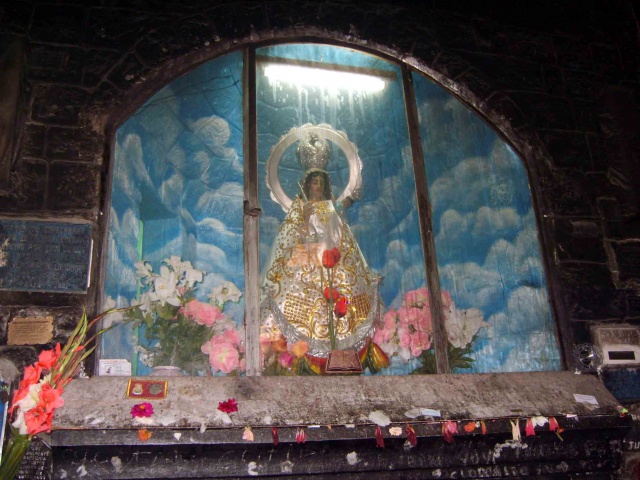
And then I saw her. Her four foot height was centered behind a glass enclosure. Her white gown with gold embroidery made her appear to be a Bride of the Solar Being, symbolically represented by the artificial light that beamed upon her head from above. A round halo around her head and a crescent moon at her feet symbolically represented the sun and the moon. The cloud-covered blue sky in the background made her appear to be ascending, or descending, from the heavens. Flowers were placed at her feet as offerings.
This was the Virgin of the Andes. She was the synthesis of all the hopes and expectations of the nations on earth. As a second Eve (the Mother of humanity), the Virgin Mary was christened the Mother of God by the Catholic church. The Andean people, however, honored and revered the image of the Virgin by other names: La Coyeta (“little queen” or consort of the Inka solar king), Copacati (“goddess of the lake,” and of fertility), Mama Cocha (“Mother-Sea,” consort of Viracocha), Mama Killa (“Moon goddess,” consort of Inti the sun), Mama Sara (“Grain Mother” or corn goddess), Mama Coca (symbol of spiritual sustenance), and Pachamama (“Earth Mother,” consort of Pachacamac, Father Sky).

We weren’t able to stay for the entire mass (service), so we silently slipped out the rear entrance and went back down the stairs to the main sanctuary.
“Did you see her?” asked the man who had helped us.
“Yes, we did,” I said with a beaming smile on my face.
“Do you know about the legend of the Lady of the Candelaria?” asked the man, who wanted to share his knowledge with us. “According to legend, a statue of the Virgin Mary was washed ashore on one of the Canary Islands. She was holding a child in one hand and a candle in the other. That’s where we get the name Candelaria. Later she was syncretized with other Virgin legends, and here in Copacabana she was combined and merged with local goddesses as a way to legitimize the Spanish conquest of indigenous territory. So now they use both names for the Dark Lady of the Lake: the Lady of the Candelaria, and the older indigenous version, the Lady of Copacabana.
“Tourists like you visit the shrine year round, but during the annual festivals on February 2nd and August 5th, pilgrims come here in large numbers. On February 2nd, they celebrate Candlemas, when candles are blessed and light is brought into the world. On August 5th, they come to celebrate the Blessed Mother of God. These festivals fall approximately at the time when the sun reaches its highest and lowest positions in the sky at Lake Titicaca.”
“We’re sorry, we’d love to hear more, but we have to catch a boat to Isla del Sol,” interrupted Susie.
We thanked the kind man and walked out of the cathedral. I felt that the Virgin of Copacabana had smiled down on us and blessed us with a hierophany – a bringing to light and manifestation of her divine nature. I stood in her presence and saw her syncretic image: as the Black Madonna she was the dark fertile soil of the earth; I felt her motherly, nurturing being in her essence as the Earth Mother (Pachamama); I understood her to be the goddess, the eternal feminine, who manifests in every culture (Greek Aphrodite, Roman Venus, Hebrew Asherah, Egyptian Isis, and Andean Virgin of Copacabana); and I realized her to be the biblical Eve, the Christian Mary, and the Andean Mamanchic – the Mother of all humanity. All her devotees were treated equally, without discrimination; her light, love, and helping hand were always available to them.
As we strolled across the plaza in front of the cathedral, I stopped to look at the intriguing statue of a bronze lady on top of a towering pedestal. It looked like it was the Andean version of the Virgin goddess. It was juxtaposed with the Virgin in the cathedral in such a way that it seemed like it was meant to complement the Christian image with an Andean image. I surmised that the lady standing in the center of a square plaza with eight walkways radiating out from the center – making the entire plaza look like an eight-directional cross – was the Dark Lady of the Lake. It seemed that both images were able to share the same sacred space at an elevated position in Copacabana.

Susie and I had to decide what to do with the remaining time that we had left. We could either climb the 150 meter (495 feet) high Cerro Calvario – the promontory that we saw when we entered the vicinity of Copacabana – or we could find a restaurant and have some lunch. Susie chose the latter. She didn’t think we had enough time to go up and down the hill.
We walked past quite a few shops on our way back down to the lake. Several shops catered to tourists from Israel; they had Hebrew words posted on signs in front of their shops. I saw one shop that had a fantastic selection of textiles, hats, and hand-woven tapestries. I had my eye set on the tapestries which portrayed life on Lake Titicaca. I was hoping to buy one of those colorful tapestries from an indigenous weaver.
Susie found a restaurant where they had a fixed lunch menu featuring salad and delicious Andean soup. That was a satiating light lunch, which replenished our energy and got us ready for our boat ride to Isla del Sol.

We returned to the bus office to pick up our bags and suitcase. There was a beautiful panoramic tourist map of the lake on the wall that I thought would serve me well. I took a picture of it for future reference.

We headed for the dock on the lake. Our timing was perfect. The passengers were just starting to line up. I took one last look at Copacabana and at the modified reed boats with wooden bottoms on the shores of the lake. The entire shoreline was a hub of activity for boaters, tourists, and pilgrims.

We embarked on the boat trip to Isla del Sol, the center of creation for the Andean world.
