CHAPTER 3 – Tiberius – Tel Dan – Caesarea Philippi (Banias)
[On way to Mount of Beatitudes]
Marian: “My main prayer is that God guide me to guide you through the Holy Land.” [In the bus, she tells us that the land is basically the same as it was 2,000 years ago, except for houses and cars.]
“Yesterday I told you that names tell you everything. I am blessed to know the Hebrew language. And names, like Amen, which you say means ‘so be it’ is not what it really means. The word is Hebrew and it comes the Hebrew word ‘Ma’amin’ (to believe). So it could also mean the Believer. So when you say ‘Amen’ at the end of a prayer, you’re actually saying, ‘I Believe.’ That’s good, because if you don’t believe, your prayer will not be worth very much. So Amen is from the word to believe.
“Sababa – yesterday’s word, meaning “cool, awesome.” How’s our driver? Super Sababa. Boker Tov – good morning. Yalla = “let’s go” So when we want to get moving, I say “yalla,” and when we want to really get moving, I say, “yalla, yalla.”
http://news-en.hebrewonline.com/content/issue-81-january-2010-hebrew-slang (slang)
“Straight ahead is Migdal. Migdal was a very large important fishing village in the time of Yeshua. It was not an ordinary fishing village, because when they got the fish, they would salt them and export them over the whole of the Roman world. And this is the beginning of understanding of the villages along the shore of the lake. My dears, these were not poor fishermen, forget that bit. These were not unlearned people, forget that bit. They knew the Scripture, mostly by heart. Mostly they could read it. They couldn’t always write it, but they could all read it.
“Not only were they fishing villages, they were also farming areas. You can see how good the farm land, and you’ll see as we travel around the lake. The fishing village of Migdal, which you can see excavated on the right, was not just fishing. It was also farming. This valley here on our left – the Arabel cliff just above us – this was the way down to the Sea of Galilee, from Nazareth and the Galilee mountains. This was the ‘Jesus Trail,’ coming down here, and you come right down to Migdal. That makes Migdal a crossroads. You’re coming east-west, and there was a north-south road that I showed you yesterday, and that was the Via Maris. And the Via Maris was an extremely important highway which I mentioned often yesterday, as joining Mesopotamia and Egypt.
“So, now we need to reconsider. These are fishing villages, and farming villages, and on a major highway. That’s a whole different story. And the reason I tell you that is that I want to give justice to a very important woman in Scripture – Mary Magdalene. As I’ve been saying all the time, the names are most important. And we’ll start with Judas, because when you say Judas, you give him a second name. And that second name is Iscariot. What does Iscariot mean?
Paul: “Sicarii, the knife people.”
Marian: “That seems like a logical answer. There is a Sicarii, but in this case it is two Hebrew words: Ish (is a man) Crioth (from the city) One popular explanation derives Iscariot from Hebrew Κ-Qrîyôth, or "man of Kerioth" [A town in the south of Judea (Joshua 15:25).] That’s important knowledge. Now we know that Judas is not like the other disciples, because they are from the fishing and farming villages. And you don’t need me to tell you that all over the world, there is a big difference between city people (city-slickers) from country people. That’s it. There’s no two ways around that. But before we condemn him as a city-slicker, what we need to evaluate is that we’re told he’s different. We’re not being told why he’s different or why he’s going to be different. We’re just being told – ‘Mark this man, he’s not from the fishing villages, he’s a city dweller. And I’ll ask you to be very careful in your decisions about Judas, because don’t forget Mary Magdalene is portrayed very often as a prostitute. And that was a sixth century decision that has no relevance to what she was, really.
“And now I’ll explain why her name is given as Mary Magdalene. Because we have the Marys who don’t have a surname, which means they are not of importance. If you give someone a surname, a second name – because they was no family names in the time of Yeshua – if you give someone a second name, you’re telling something about that person. The other Marys do not have that significance. They are not significant people. That’s why in the sixth century they took all the Marys, put them all together, and made it all Mary Magdalene. But that doesn’t work for us in the 21st century.
[Alongside the road – a pumping station that pumps the water from the Sea of Galilee.]
“The Sea of Galilee is Israel’s water source. Without it, Israel would not exist. The pump takes the water from 200 meters below sea level and brings it up to sea level, and then by gravity to the rest of the country, using wells and other sources of water that we have along the way. This sea, which is a lake, which is our source of water is a source of faith for Christianity. This is the place of the ministry of Yeshua. Now how amazing is that. That something totally physical for the people of Israel is something totally spiritual for Christianity. And I find that to be probably not by chance. We’re both drinking from the waters -- one physically, one spiritually. Look how beautiful the Sea of Galilee is. They didn’t have a word for lake in the Bible, so they called it a sea. But this is, of course, a lake. And tomorrow morning, we going to be actually on the lake in one of the Worship Boats that we use for pilgrims.
“So let’s get back to Mary Magdalene. Why is she given a second name – so that it tells us that she came from the town of Migdal. Migdal means a tower because there was a tower for defense, but it was a rich city. And we know it was rich because we know they didn’t just fish, but they salted, and exported the salted fish, and it was famous throughout the Roman world. The ancient name was Tarfia, and it was a well-known city. [The town is named after the old city of Migdala Nunia (Aramaic: "fish tower"), home town of Mary of Magdala (Luke 8:2), and is situated just west of the Kinneret on Tiberias-Rosh Pina road]
“So if they’re telling you Mary is from Migdal, that’s the point they’re trying to make. She’s a rich. It’s like saying this person is a ‘New Yorker’ – and you will all understand what that means. So if you said in the ancient world that she is from Migdal, everyone would understand this is a woman of means. In fact, several verses afterwards in Scripture it says that she supports the disciples. She has the money to support the rabbi and his disciples as they go from city to city. Very much like today, where preachers or rabbis are supported by churches. So I beg to reconsider Mary Magdalene as an important supporter of Yeshua. So much so, that she was probably in charge of finances or financing the disciples as the go through the Galilee.
“Now, everything that I say is open to discussion. Which means just because I said it that it’s the Word of the Lord. So these are just ideas, because I live here and I am lucky to walk in the footsteps of Yeshua for a very long time – I just want to offer them to you as they appear to me.
“And now we’re on our way to the Mount of Beatitudes. You know it as Sermon on the Mount. And we have a small discussion, a small prayer, and Stephen will give us a reading from the Bible.
“And I want to share a few Hebrew words. You know that when words are translated, a lot is lost in translation. So when we talk about Sermon on the Mount, we have to remember that Jesus gave this sermon in Aramaic – people would read Hebrew, but speak Aramaic – and by the way not the Aramaic of Mel Gibson (movie Passion). He got that wrong, as well as a lot more. He would speak Aramaic, which was translated into Greek. So the New Testament in Greek was translated into Latin, which was then translated into the other languages. So things got lost in the translation. And what I’ll try to offer you is the Word as it was originally spoken. And so the first thing we need to do is go from the English, that we have today, back to the original Greek. And that would be the closest to knowing exactly what Yeshua was saying. And the original Greek for Beatitude, which we translate as ‘blessing’ or ‘blessed be.’ The word was quite different. The word in the Greek is Makarios, and makarios is the word for joyful (happy). The fullness of the Spirit. So actually, it’s not blessed are, but joyful are.”
[Sermon on the Mount -- at the Mount of Beatitudes]
The church is shaped like an octagon (8 sides). Based on 8 beatitudes. The front façade (7 arches) looks like a Menorah.

Marian: “This will be a good time to go inside. It’s a very simple church. It is done by a great architect named Antonio Barluzzi, who was an Italian architect. He did the building (designing) of all the churches after the 1920s. In the 1920s – after 800 years of Muslim rule – this area became Christian. And when it became Christian, the British had a mandate here. And the only good thing the British did – sorry, anybody British here? – the only good thing they did was they got this great architect to build the churches for them. And you’ll see how beautiful it is, and how special. It has the Barluzzi touch, which means because we’re talking about humility, and being not proud, being simple, obedient, the church gives you that feeling. And then you have the eight windows for the eight beatitudes. Look up and you see a simple golden dome, because these are our golden truths. And the little bit of blue (with stars) lets you know that it’s all up there.” (pointing towards the heavens)

“Black basalt is the stone of the area. We are in a volcanic area. The Golan Heights – on the other side, I mentioned it yesterday – has the black basalt. So this black basalt was brought from the Golan Heights. The ancient building was built with this stone. So Barluzzi takes this into account when he’s building here. And each window is slightly different to represent the difference in each beatitude – a different view of life, and a different view of the scenery, which is like a different view of life. And then he does these little things, like the style of the capital of the column. So these are brilliant Barluzzi things – and the use of black and white, which was popular in ancient times. This will give you an idea of how lucky we were that he was available.

“We’re going to a little area, reserved for us, where we’ll have a Bible reading.”
Stephen Miller (age 31) does the Bible reading: “If you have your Bibles, I will be reading from Matthew, chapter 5, 6, and 7. I’m not going to read the whole thing, because there’s a lot, but I wanted to read a few points for you, starting in Chapter 5:
New International Version (©1984)
The Beatitudes
1 Now when he saw the crowds, he went up on a mountainside and sat down. His disciples came to him, 2 and he began to teach them, saying:
3 “Blessed are the poor in spirit, for theirs is the kingdom of heaven.
4 Blessed are those who mourn, for they will be comforted.
5 Blessed are the meek, for they will inherit the earth.
6 Blessed are those who hunger and thirst for righteousness, for they will be filled.
7 Blessed are the merciful, for they will be shown mercy.
8 Blessed are the pure in heart, for they will see God.
9 Blessed are the peacemakers, for they will be called sons of God.
10 Blessed are those who are persecuted because of righteousness, for theirs is the kingdom of heaven.
11 “Blessed are you when people insult you, persecute you and falsely say all kinds of evil against you because of me. 12 Rejoice and be glad, because great is your reward in heaven, for in the same way they persecuted the prophets who were before you.
13 “You are the salt of the earth. But if the salt loses its saltiness, how can it be made salty again? It is no longer good for anything, except to be thrown out and trampled by men.
14 “You are the light of the world. A city on a hill cannot be hidden. 15 Neither do people light a lamp and put it under a bowl. Instead they put it on its stand, and it gives light to everyone in the house. 16 In the same way, let your light shine before men, that they may see your good deeds and praise your Father in heaven.
Chapter 6:19 - 19 “Do not store up for yourselves treasures on earth, where moth and rust destroy, and where thieves break in and steal. 20 But store up for yourselves treasures in heaven, where moth and rust do not destroy, and where thieves do not break in and steal. 21 For where your treasure is, there your heart will be also. 22 “The eye is the lamp of the body. If your eyes are good, your whole body will be full of light. 23 But if your eyes are bad, your whole body will be full of darkness. If then the light within you is darkness, how great is that darkness! 24 “No one can serve two masters. Either he will hate the one and love the other, or he will be devoted to the one and despise the other. You cannot serve both God and Money. 25 “Therefore I tell you, do not worry about your life, what you will eat or drink; or about your body, what you will wear. Is not life more important than food, and the body more important than clothes? 26 Look at the birds of the air; they do not sow or reap or store away in barns, and yet your heavenly Father feeds them. Are you not much more valuable than they? 27 Who of you by worrying can add a single hour to his life? 28 “And why do you worry about clothes? See how the lilies of the field grow. They do not labor or spin. 29 Yet I tell you that not even Solomon in all his splendor was dressed like one of these. 30 If that is how God clothes the grass of the field, which is here today and tomorrow is thrown into the fire, will he not much more clothe you, O you of little faith? 31 So do not worry, saying, ‘What shall we eat?’ or ‘What shall we drink?’ or ‘What shall we wear?’ 32 For the pagans run after all these things, and your heavenly Father knows that you need them. 33 But seek first his kingdom and his righteousness, and all these things will be given to you as well. 34 Therefore do not worry about tomorrow, for tomorrow will worry about itself. Each day has enough trouble of its own.
Chapter 7:7 -- 7 “Ask and it will be given to you; seek and you will find; knock and the door will be opened to you. 8 For everyone who asks receives; he who seeks finds; and to him who knocks, the door will be opened. 9 “Which of you, if his son asks for bread, will give him a stone? 10 Or if he asks for a fish, will give him a snake? 11 If you, then, though you are evil, know how to give good gifts to your children, how much more will your Father in heaven give good gifts to those who ask him! 12 So in everything, do to others what you would have them do to you, for this sums up the Law and the Prophets. 28 When Jesus had finished saying these things, the crowds were amazed at his teaching, 29 because he taught as one who had authority, and not as their teachers of the law.
Stephen: “What he said was totally revolutionary for that day. You know, people – a lot of the Jews – looked to the Pharisees as that which we aspire to be. The outward appearance was what mattered. And he revolutionized everything by talking about the heart – what’s between you and God that really matters. Pretty amazing. You guys have anything to add to this?”
Pastor Tom Burns: “Steven, how old are you?”
Steven: “31.”
Pastor Tom: “You know, when Jesus stood up, he was about the same age as you.”

Leslie Burns leads the group in a song: “Seek ye first the Kingdom of God”
Seek ye first the Kingdom of God
And His righteousness
And all these things shall be added unto you
Hallelu, Hallelujah!
Man shall not live by bread alone
But by every word
That proceeds from the mouth of God
Hallelu, Hallelujah!

Marian: “Yeshua is very often quoting from Psalms. Everybody knew what he was saying, and everybody immediately related to Psalm 37. It’s a psalm that asks, Why do these wicked people prosper? Why do the righteous suffer? You know, it’s a psalm that touches the heart. We look around us and we see dreadful people prospering. And how do you explain that? ‘Here I am, God, I’m trying to do my best, and all I get is pluck, pluck, pluck – which is not verbally correct – but you know what I mean. So Psalm 37 tries to answer that question. Verse 11 points out the success of the unrighteous, and then it gives the answer. And the answer is that you will inherit the earth. (v.11 - But the meek will inherit the land and enjoy great peace.)
“The Romans are here right now, but they will not be here forever. That’s Psalm 37. And what Yeshua does is that he talks about two different things in Matthew. He talks about the kingdom of earth, and then a few lines later he does what I like to call the ‘Jesus Twist.’ And the Jesus Twist is that he then begins to talk about the kingdom of heaven. What he’s saying to them is something revolutionary, because the Jewish people at this time did not have a set idea of the next world. So what he’s saying is, ‘What you don’t get in this life, you will get in the next life.’ That was revolutionary. It was new.”
“We have this spot only til 9 o’clock. We each have allotted hours here. I managed to fit us in. I don’t want the nuns to get angry. They go around here, and they have this whole thing under the control of the Catholic church.”
“Are we OK to move on?”
All: “Yes!”


[Discussion about Mount of Beatitudes - in the bus]
Marian: “I didn’t go into a discussion of whether this was the right place or not. That is because Luke was saying that Jesus was praying the whole night. Then at dawn, when the disciples come, he goes down. Luke 6:17 – “And he came down with them and stood in the plain.” And Matthew says he goes up. Matthew 5:1 – “And seeing the multitudes, he went up into a mountain.” That was a little confusing, and it would be hard to know exactly where it was, unless, of course, they met in the middle.
“One possibility would be halfway up the mountainside, in which case both Matthew and Luke would be right. In the case of Matthew he would have gone up, and in the case of Luke he would have gone down – the halfway point, but not all the way down. That would make sense. And Luke is quite right, really, to put it that way because Luke is very Greek. Luke is a very Greek-understanding person, and in the Greek world you sit on the side of the hill. And the actor is below. Remember Caesarea, based on the Greek concept of sitting on the hill. So Luke was thinking of the Greek theater, which would easily sit 5,000 people.
“The one at Caesarea only seated 3,500 – it was really small. We have one in Beth Shean that sits 7,000. You don’t need a microphone. And 7,000 people can hear you if they’re on the slope of the hill. So you know, a lot of people are running around trying to figure out if he spoke from the bottom of the hill so the people could hear. It wasn’t like that at all. It was somewhere in the middle. And Jesus would have been a little below them on the slope. And that would be perfectly natural.
“I did mention four sacred sites. One of them is just above us. Safed – you can see the houses on top of the hill. It’s just a possibility that when Yeshua says, ‘A city on a hill cannot be hid,’ he was actually referring to Safed. We also have higher hills – like the upper Galilee – the area where we were going through yesterday. The lower Galilee went up to about 500 meters. Now begins the upper Galilee, and it goes up to a 1,000 meters. So Safed is about 900 meters above sea level, and that is where they have the Kabbalah. I know that some people know that Madonna goes for this Kabbalah, but her Kabbalah is a little bit different from the spiritual Kabbalah, the mystical side of the religion. The non-commercial bit of the Kabbalah is what I’m trying to say.
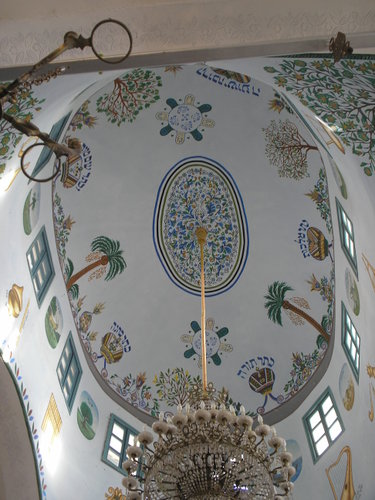
[Note: I went to what Marian referred to as "a city on a hill" (i.e. Safed). See the addendum at the end of this chapter to see the special Kabbalah-related Abuhav Synagogue in Safed that I visited.]
“Whenever Yeshua speaks, it generally is pointing to something. And I didn’t give much credit to the church on the mountainside. If you go just a little bit down, you have the city of Tiberius right opposite you. We were on the northern side of the lake, and Tiberius is right in the middle, on the western shore of the lake. And that would make sense, for when he spoke about the unrighteous prospering, he would probably mean those who were living in Tiberius. Because those were the Jewish people who were not his audience. You never hear of Jesus going into Tiberius. He’s not going into Caesarea, and when we get to Caesarea Philippi, he doesn't go in there either. He goes to ‘the region of.’

“When you look at Jewish history, throughout the ages, and even in the Bible, you actually begin to understand a people who worked as a collective. We can take it right back to Joshua, and they’re told not to take the spoils of Jericho. One man does, and they all suffer. So this is collective thinking.
“I’ll jump from there to Europe – and Jewish people being dispersed throughout the world. And when they were dispersed, they lived in communities. They didn’t lives as families on their own. They formed a Jewish community in whichever city they settled. And in these communities, there was always a soup kitchen, there was always an old age home, long before social services. And the reason they had all that, and the reason they looked after one another was because they had a collective mind-set. I sometimes think that the success of the country the last 55 years (we’re 62 years old) – the success of the past 55 years was our ability to work as a collective. My great fear is that when we stop doing that, we will lose out. We lose that understanding of working as a collective.
“Right now we are at Rosh Pina, which is one of those early settlements from the 1880’s, and if you look at the eucalyptus trees, you know that it was a swamp area. The early pioneers came here with no train lines here. From here there’s a road that goes up to Safed (“the city on a hill”). These are part of the mountains of Naphtali, the tribe that lived in the north.
“So I wanted to explain this collective idea. If you know Russian history, you know that a lot of the people who led the Russian revolution of 1917 were actually a lot of Jewish people who had the collective mind-set. And they put it into socialist ideas, which later sadly became communism. When they made the revolution, they weren’t expecting communism. They were expecting Social Democracy. But here in Israel, we have a socialist country, and a democracy.
“A collective can be as much as 2,000 people. And then I was telling you on the first day that our first bus company was a collective of 4,000 buses working together. People were thinking in the collective mind-set. And therefore, socialism is almost a direct continuation of the collective.
“Straight ahead of us – we’re actually coming to the border with Lebanon. And our first sight is going to be very much on the border with Lebanon. As I told you before, there is no private land. It’s all state-owned. The state gives each kibbutz a certain amount of land according to their size. When you see a very large field, it’s almost always going to mean a kibbutz. People work the land together. But, in the 1920s, there were a lot of families who couldn’t agree with the idea of complete communal working together. For it meant everybody made a decision about their kids. And that was difficult for some mothers. Children slept in a children’s home, and the parents slept separately. It was all communal, and the kids grew up together. You saw your parents for about one hour in the afternoon. So a lot of parents couldn’t go for that. Therefore, in the 1920s, they came to a decision to form a Moshav. A Moshav is a semi-communal place where people work their own land, given by the government. They have their own house, but they share communal tractors, which are state owned.”
[On the way to Dan Nature Reserve]
Marian: “Do you remember the story of the patriarchs? (answer: yes) So we know that Abraham makes a covenant with God, and he understands that there is only One God. This covenant of the land will be passed on to his sons. It goes to Isaac, and from Isaac it goes to Jacob. And yesterday when we were reading Scripture, we saw that Jacob’s name is also Israel. So Israel -- at the end we have EL – and EL is the word for God. So “Isra” can mean one of two things: we can translate it as ‘striving with God’ (and I would go with that one because the Jewish people have been striving with God for thousands of years); or ‘Champion of God.’ Both are possible. And you know of the story of the angel fighting with Jacob, and you notice that he wouldn’t let the angel go until he changed his name. So you wonder, Why? What’s wrong with Jacob?
“So is anyone named Jack before I go with this one? In one version it’s translated as deceiver, but it actually comes from the Hebrew word for ‘heel.’ It’s because when he’s born, he is born with his brother Esau; Esau is born a bit before, and Jacob is holding on the heel. So they called him, ‘You Heel.’ You can imagine this guy going through the Bible with a name like ‘You Heel.’ While he’s acting like a deceiver, he cannot have his name changed. But his character will change when he grows up and marries two wives. And you notice that as a deceiver he is deceived by his wife-to-be. I don’t know how it happened. But you can imagine waking up in the morning and – hello! (laughter) I have a big question mark there. But so you know that Jacob means heel, I can prove it. I had a woman in the bus last week, and when I finished telling the group that Jacob means ‘heel,’ she said, ‘You’re absolutely right. My husband’s name was Jacob and he was a heel.’ (laughter)
“That’s a true story – I got to tell you. It’s one of the few love stories that we have in the Bible. Jacob falls in love with Rachel, but then he’s tricked into marrying Leah. And now he has two wives. And wouldn’t you know it, Leah goes and has all the kids. Now this is a big thing in Middle Eastern society. In Europe it’s not such a big thing, if you don’t want to have kids, and you live happily. Not in the Middle East. It’s a family-orientated thing, and without kids you’re not part of society. So you can understand Rachel when she sees Leah having son after son – not just a child, but a son – so Reuben is born (“God sees my sorrow” because she’s not a beloved wife), then Simeon is born (“God heard her sorrow”). And then the third son is called Levi – you know – the priests. The Levis – the guy who made my jeans. (laughter) Levi comes from the Hebrew word ‘le lavot’ (to go with). So when you have two kids, the Mom gives a hand to each kid, left and right. But if you have a third child, the father has to come along. He has to accompany her, so he is now called the ‘accompanier’ because the husband has to accompany her. And then she gets a fourth son. She’s really happy, and she calls him Judah. And that means ‘thanks’ (toda), or Judah (thank you). Now she’s really happy. And there’s poor little Rachel, she’s crying her eyes out because she doesn’t have any children. So she cries to God, ‘Give me children, lest I die. My life is not worth anything without children.’
“Then God sees her plight, and he gives her children. But he doesn’t give them directly to her, but to her handmaiden. Her servant’s first son – Rachel chooses the name – she calls him Dan. Dan means ‘to judge.’ God judged me, but I’m not being punished for something bad that I did. And that’s how we get the name judge for Dan – this tribe. In a later prophecy, it says, ‘Dan shall judge his people.’ But it’s more a play on words than actually being a judge.
“So Dan is a child from Rachel’s handmaiden. And then the handmaiden has another son, Naphtali, and these are his mountains. The area of Naphtali. Finally, Rachel will have her own children. As soon as Leah sees that Rachel gets children through her handmaiden, Leah get more children through her own handmaiden. And then Rachel actually has children: she has Joseph, and then the baby Benjamin. Benjamin’s name is an interesting one, because it’s a play on words. If Rachel chose the name because she dies giving childbirth, the name can mean ‘Son of my Sorrow,’ but it can also mean ‘Son of the South,’ because he’s actually born in this country. Whereas the other ones are born while Jacob is working for Laban.
“So we’re on our way to a Tel, which is also a nature reserve. And we’re going to walk through the nature reserve. It will be over an hour walking through the nature reserve.”
[Dan Nature Reserve]
Tel Dan, Dan Nature Reserve http://senkfor.com/banias,_tel_dan.htm
Marian: “Syria had the Banias River, and we had the Dan River. Today we have both Dan and Banias flowing into the Jordan River. So we’re much safer with our water today than we were before 1967, before the six-day war. The mountains here became part of Israel. Today all this belongs to Israel.
“We’re turning off here to go to Tel Dan. The Danites didn’t like their region, near Tel Aviv. So they came up here. And gee, did they make a right decision. They came to a well-watered area.
“Now look ahead, and you can see a village that is half in Israel, and half in Lebanon. The border between us is going through the village. [Ghajar is an Arab village half inside Lebanon and half inside territory that Israel captured from Syria in 1967.]
Kim’s: “How does that work?”
Marian: “Not good, because they’d rather be in Israel, and that’s not good. You have to understand that the Israeli economy is really strong, so the Lebanese would rather be in Israel. They would have social services, a good economy, the elderly looked after. Wouldn’t you prefer that? This is not politics, this is how to live your life.
“Some parts we’re going to be walking right by the river, and there I’m going to ask the women to help the men over the difficult bits. (laughter) And it’s slippery, so take your time. Some parts may be muddy because it rained yesterday. We’ve had two days of rain. 80% of the trail is easy, and just a small percent is difficult.
“We have a National Parks card, and what I do at the end is give everyone a card. So you’ll have all the sites we visited with a hole in (the card), so you’ll know we visited it.
The Banias (Arabic: Banias, Hebrew: Hermon), arising from a spring at Banias at the foot of Mount Hermon. The Dan (Hebrew: Dan, Arabic: Leddan), whose source is also at the base of Mount Hermon.


Marian: “We’re taking the long trail. It’s the most beautiful. It goes along the river. So we’re starting here at the park, right at the very entrance. And we crossing over this particular little piece of river now, which comes from Ein Dan, which is the spring of Dan. So the waters of the spring of Dan are partly from the melted snow of Mt. Hermon, so if you look at the water – if you’ve been to Scandinavian countries, you know what the water of snow looks like when it begins to melt – and you’ll see the (bluish-grey) color in the water here. But this is our first glimpse of a lot of water in Israel. Then we’ll come to some nice spots where you can make some photographs. And then we’ll continue – you see, the path goes like this (shows on the map), and when we come to this bridge, I’m going to stop there.”

Ron: “Are we going to the Hermon Reserve where the waterfalls are?”
Hermon Reserve http://www.parks.org.il/BuildaGate5/general2/data_card.php?Cat=~25~~837878172
Marian: “No.”
Ron Moseley: “We’re not? Good.” (laughter)
Marian asks for one volunteer to be the last person, making sure no one gets left behind.
Kevin: “Who wants to volunteer to be the last person? Dr. (Ron) Moseley?
Marian: “Dr. Moseley, we need you.
Paul: “The first shall be last.”
Dr. Moseley volunteers.
Kevin: “You’ve just redeemed yourself from this morning.” (laughter, group recalls waiting for Dr. Moseley, who came late on the morning bus).
Marian: “So when we see Dr. Moseley, we’ll know that the whole group is here. Don’t get behind Dr. Moseley, because then I’ll think everyone is here. OK, let’s go.”
We stop at a place where there are tall canes, or bulrushes.
Marian: “In Hebrew it’s called “canai” (?) And it becomes the word for ‘straight.’ And it goes into the English as cane.”
Paul: “But is it sugar-cane?”
Marian: “And, yes, then it becomes sugar-cane.”
Paul: “But is it sweet?”
Marian: “No, the word sugar is added to the word cane. Cane is a long, thin stick. Like the stick or cane that was used in British schools for hitting children. And then there’s the town of Cana, where the first miracle was performed. Cana is from this (cane, bulrush), and it should be an area that had canes. But that’s just a possibility. So this is cane, and you’ll know it sometimes as bulrushes.”
Ellen: “Is it the same as bamboo?”
Marian: “No, but you see how straight it is. So it becomes a symbol for something long and straight. Something that is correct.”

Devotional time with Pastor John Miller: “We speak of the tribe of Dan, and there’s an irony about this place as you walk through it. To me it’s like – I don’t know what the Garden of Eden looked like – but this is like Paradise. And yet, things fitting to Paradise did not happen here. I’m going to read a portion from Judges -- remember Judges is a period of time in the Israelites history where everyone did that which was right in their own eye. And a couple of these chapters start off saying, ‘And in those days Israel had no king.’(19:1) And certainly, they did not follow the King – they didn’t follow Yahweh. They broke away, they got up here, far away from God. And in Judges 18 verse 28, the city was in a valley near Beth Rehob. The Danites rebuilt the city and named it Dan, after their forefather Dan.
New International Version (©1984)
(29) They named it Dan after their forefather Dan, who was born to Israel--though the city used to be called Laish. And Jonathan, who was “a priest” – I say a so-called priest because he was an Israelite-pagan priest. A real conglomeration here.
(30) There the Danites set up for themselves the idols, and Jonathan son of Gershom, the son of Moses, and his sons were priests for the tribe of Dan until the time of the captivity of the land. (31) They continued to use the idols Micah had made, all the time the house of God was in Shiloh.
“This Micah is not the prophet Micah. Micah was like a combined a combined belief in Yahweh and in Baal. Paganism. They were combining the belief in the True God – which of course distorts everything – it makes them feel good, like they’re staying true to their roots. And yet, they’re devising the pagan god so they can bring him in so they can actually live the life that they really want to live. In other words, to the flesh. And I’m telling you, that’s a temptation that we can all have – to take the God we know, and the god we’d like, and combine them for the ‘perfect life.’ For the satisfaction of the flesh. So the place where they settled here, they had the opportunity to honor God in a place of God’s creation, and yet they spent their time in revelry and pagan idol worship, and horrible acts. They must have deeply dishonored Almighty God. So this is not a great historical moment for the people of Israel. But it’s a reality that ought to speak to all of us – to what can happen if we drift from the Lord.”
Marian: “There’s something terribly wrong going on here. And that’s why, when Jeroboam becomes king, after the kingdom was divided. You may remember – Solomon may have been wise, but his son was really stupid. And you may remember they come to his son, and they say, ‘We understood you wanted the money from our tribe to build the temple, your father – that we were OK with. What we need to work out now is – who are these ten tribes?
“By the way, these maps that I handed out in the bus that has the bus routes in Israel – the other side has a pilgrim map of tribal areas. And when you look at the tribal areas, you suddenly realize that the ten northern tribes are the rich ones. They’re the ones with the money. Not by chance Solomon is asking them for payment. And when he does that, he does something which really can be considered very wise. Because he takes – we know nobody likes to pay tax – so what he does is say, ‘One month of the year, every tribe will pay tax. But not Judah, of course, for Judah was Solomon’s tribe. Not them. They won’t be paying tax. But everybody else will. And then, he doesn’t do it exactly by tribe. He does it by how rich an area is. So if there’s an area that is considered rich, and it’s just part of a tribe, they’ll pay for one month of the building of the temple. But then thereafter – the rest of the year – they just have to pay one month. But it was still a lot of money. And when the building was over, they come to Solomon’s son and say, ‘OK, we helped, we built the temple, and we don’t want any more.’ But then Solomon’s son had these stupid advisers who say, ‘Why should you? You’re king -- like the famous line, it’s good to be king – so you’re king.’ And then he oversteps the boundary. Don’t forget, the social mind-set, which is what I’m trying to show you – you can find it in almost every story – and here the social mind-set says he overstepped the border, the line.
“I want to give you something that’s not connected, so you’ll understand. When we first had enough money – you know this country went from being very poor in the 1950s to being a little bit richer in the 1960s, and by the 1970s people were quite financially OK, and by the 1980s we could begin to travel abroad. That was like the big thing. So when we traveled abroad, I was dying to go to a Scandinavian country, because I had this thing about ice and snow that we didn’t have. We didn’t have Mt. Hermon until 1967. So it was always my dream. And the first place we go was to a Scandinavian country. And we get to the city, and what they’re showing us there is the municipality building. That was the big thing. I couldn’t get it, because in our country, if your municipality builds a big palatial building, you kick him out. ‘What do you mean taking tax-payers money and building a big building for the municipality. That can’t be right. The municipality money is for us. Not for the municipal building.’ So just to see how different the mind-set was – I’m telling you this story.
“So here these are the tribes saying, ‘Ok, you’ve got your temple, you’ve got your big palace.’ You know Solomon took fourteen years to build the palace, and only seven years to build the temple. That tells you enough already. And here’s Rehoboam saying no. So Jeroboam says, ‘Look, we’re the ones with the money.’ Money talks. ‘We don’t need you, and we won’t come to your temple.’ That was his mistake. And then he puts up a golden calf, one at Dan, and then one at Beth-El. The borders of his kingdom. Now no one from the northern tribes is going to go to Jerusalem. But, my dears, that was a mistake. Because 200 years later, there is no northern kingdom. You forget Jerusalem, God will forget you. And they disappear from history.
“So now we’re going to an area which is an excavated area, which is a high place. And there I’ll talk about the high places, because that is something that everybody wants to understand – what is a high place. So what we were talking about now was the sin of this tribe, which is carried on from the statue of Micah to the golden calf of Jeroboam. And the city disappears. They didn’t get it.
“And I want to say one more thing: when we get to Jerusalem we encounter a city that has nothing going for it. Certainly it doesn’t have this ‘Garden of Eden’ feel about it. The middle of the mountains, no water, no agriculture – it’s a city that has nothing going for it. And then just compare what this is today – that had been a great city in ancient times, and what’s here today – and with what we have in Jerusalem today.
“You know, people often ask me how I got to my faith, because you’re not born immediately with faith. It’s something that you all grow into, or grow away from. And I wasn’t born into it – we had arguments, no, I should saw we don’t argue in the Jewish religion, we have discussions, and when it’s loud we call that ‘lively discussion.’ (laughter) So I grew up with all these lively discussions going on. It was very hard for me to come to a decision. And I made my decision as I was going around as a guide, and as I was going around the country, and I would say, ‘Oh, my God, I see it now.’ So as you go around the country you see it. I see Jerusalem, and I see Dan, and I say, ‘I get it.’ What more do you need to know? You see here desolation where it should be a thriving city. You see Jerusalem, which should be desolation, and you have a thriving city. OK, my dears, so I just wanted to point that out to you.”
Ron Moseley: “May I make one observation?”
Marian: “Sure, you’ve been very quiet up until now.” (laughter)
Ron: “The Psalmist remembered when he was close to God, he says (Psalms 42:6-8), “My soul – he’s talking about this place right here -- “O my God, my soul is cast down within me: therefore will I remember you from the land of Jordan, and Dan (Hermon) and Mount Mizar. Deep calls to deep in the roar of your waterfalls (at Dan); all your waves break and have swept over me.” And – this is good enough – but the one next door – it just BOOM! Comes down. Most people think, well, there’s nothing here scripturally – but there’s plenty here scripturally.”
Marian: “Yes there is, certainly.”

[Devotion at Tel Dan, Dan Nature Reserve]
Leslie leads the group in a devotional song:
“Lord You are more precious than silver,
Lord You are more costly than gold,
Lord You are more beautiful than diamonds,
Nothing I desire compares to You.”

Paul: “The birds are singing, the streams are singing.”
Marian: “I know. I think this is a moment you’ll remember.”

[High Place of Dan]

Marian: “Where you see the people (on top), that’s the level of the tel. And this was their biggest, and maybe most important, find. It was the cultic center of Dan. Now, we already know that Jeroboam sets up the golden calf here. And we’ve always wondered what a high place looked like. When they found that circular altar in Megiddo, everybody was sure that that was a high place. They had seven steps going up, and it was circular, a place for sacrifice. But it was very hard to understand what a high place was because when we read, for instance, in the book of Samuel, we have this great story of how Saul is chosen to be king. So Saul gets to be chosen to be king cause he is a head – tall, dark, and handsome (laughter) – he’s a head taller than everyone else. I don’t know it that’s such a good idea – to choose your king like that. He’s chosen, and he has no idea he’s going to be king. He goes off looking for – I’ve got to be careful how I say this – his father’s asses. I don’t want to say that wrong. OK, you understand I don’t want to make a mistake.”
Ken: “No mistake.”
Marian: “The ones looking for him tell him there’s a seer in the town. And that means the word for prophet – they also use the word for seer. And he can’t go to a prophet because he doesn’t have any money – he doesn’t have anything to give him. If you go to a seer, you have to bring some kind of a present. [I Samuel 9:7 -- Saul said to his servant, “If we go, what can we give the man? The food in our sacks is gone. We have no gift to take to the man of God.”] When you went to a seer you gave him some food – something – then he would do the seeing for you.
“Then we have an amazing story. We have a story – it doesn’t happen here – but what’s relevant is the high place. Samuel says to Saul, ‘We’re waiting for you. Go up on the high place and we will eat there. [I Samuel 9:19 - “I am the seer,” Samuel replied. “Go up ahead of me to the high place, for today you are to eat with me, and in the morning I will let you go and will tell you all that is in your heart.] And there’s about thirty people with him. So we were confused: How do you go up to a high place to eat? Where are you going to sacrifice? Where did the golden calf go? How are you sacrificing next to the golden calf? And then they discovered this cultic area.

“Now, where you see the iron (altar), that was the altar for sacrifice. Below – you see the corners have the horns, that would be the top of the altar -- below would be the area of the fire. And you would put your bull, either cut in pieces or in one piece – I don’t know how they did it – here it shows it as one piece, but very often it was cut up – afterwards or before, I’m not sure about that. But anyway, the sacrifice would go on top, and sometimes we have a sacrifice that has to be completely burned. And when we have a sacrifice that has to be completely burned, the ashes are sacred. So just alongside – on the left hand side there – was where the sacred ash was put. And then -see the stairs behind the altar? That’s a high place. And when we go up there, we’re going to see the place for the rooms. Cause in the book of Samuel, when – it talks about this, and we can read it when we can on top, if you have your Bibles with you – in I Samuel 9. And when we go on top you can see where the rooms were. And maybe even a possibility of where the golden calf may have stood. Because it’s my guess – because it’s the date, the steps are from the time of Jeroboam. Isn’t that amazing? So I think it would be good for us to go up there and stand on top, and if we can get I Samuel 9, we can just have a quick look at it. Come.

“These steps are 2,800 years old.”
[Kevin and Paul comment on the good job done with the stonework, straight lines.]
Paul: “Almost as good as the Inkas.”
Kevin: “Look how they tapered the stones. It had to be a tight fit.”
Paul: “You don’t have to use mortar or anything.”
Kevin: “Yeh, they got them up real tight.”
Marian: “I’m standing here where the steps were added on to the other steps of the high place. I Samuel 9 is the story I was talking about.”
Pastor John: “Are we standing on a high place?”
Marian: “Yes, we are. And I have a feeling that the golden calf was – just here” (pointing nearby).
Pastor John Miller reads: 19 “I am the seer,” Samuel replied. “Go up ahead of me to the high place, for today you are to eat with me, and in the morning I will let you go and will tell you all that is in your heart. 20 As for the donkeys you lost three days ago, do not worry about them; they have been found. And to whom is all the desire of Israel turned, if not to you and all your father’s family?” 21 Saul answered, “But am I not a Benjamite.”
Marian: “I just want to explain, in case you forgot. The Benjamites – at the end of the book of Judges – are almost destroyed. You remember the Levite who had a wife who was a concubine? [Judges 19-21] And I don’t want to go into what this guy was like. That tribe was nearly destroyed. So now it does not make a lot of sense that a Benjamite should actually get to be king.”
Pastor John continues reading: 21 Saul answered, “But am I not a Benjamite, from the smallest tribe of Israel, and is not my clan the least of all the clans of the tribe of Benjamin? Why do you say such a thing to me?” 22 Then Samuel brought Saul and his servant into the hall and seated them at the head of those who were invited—about thirty in number. 23 Samuel said to the cook, “Bring the piece of meat I gave you, the one I told you to lay aside.” 24 So the cook took up the leg with what was on it and set it in front of Saul. Samuel said, “Here is what has been kept for you. Eat, because it was set aside for you for this occasion, from the time I said, ‘I have invited guests.’” And Saul dined with Samuel that day 25 After they came down from the high place to the town, Samuel talked with Saul on the roof of his house.”
Marian: “And that’s the thing. We want to understand that they’re going up to the high place together. Thirty people can eat here. They’re coming down from the high place. The altar was there (pointing, a little below). We couldn’t get it. Until we discovered what was here. I don’t know if anyone else has tried to understand how it actually was, but it’s really difficult. It’s not the highest place. It’s just higher than the altar. So it’s a high place. So thank you for bringing your Bible and reading the place that proves that the high place was actually here.

Marian points out the landmarks from the high place: “Now, over there, the mountain top is Lebanon, a Hezbollah outpost. There is the village I tried to show you from the bus, which is half in Israel and half in Lebanon. Needless to say, this is your country down there. So up until 1967, we had an enemy up on those hills. These are major hills for Israel to control. You can see a red line but into the rock over there. And what Syria was trying to do was divert the waters of the Banias (River) – to take it from there all the way over the Golan Heights and straight to Jordan – without that water coming into the Jordan River, without it coming to Israel. Jordan (River) has three sources: Hasbani, which flows from Lebanon; Banias, which used to be in Syria but is now in Israel, and the Dan.
“So this was our border until 1967. It’s quite amazing, because we know of Dan always as a border. ‘From Dan to Beersheba.’ So this is like the border. Also, it’s interesting to notice, we’re in this valley, which was a major highway. Not today, but in ancient times it was a major highway – from here you could get to Tyre and Sidon, the Phoenician cities. That’s why, in the Bible, it was easy for the tribe of Dan to conquer this city here. Their closest ally was way over here on the shores of Tyre and Sidon. There was nobody to help them. ‘Let’s go and get them.’ It was a pretty strong city, but there was not going to be anybody to help them. They were on their own here. And then the Danites capture it. And it’s the only city that is actually named after a tribe. All the other tribes have a territory, and their cities are different.
“So up here are bunkers, because this is the border. And you can see tanks. Now, if you see a tank, be sure it’s not an Israeli tank. We never leave an Israeli tank in the area. So it’s one of the Syrian tanks that was captured and left here to remember the war of this area.”
Pastor Tom: “So this was a battlefield, right here?”
Marian: “Of course, because this was the border until 1967. And when they tried in 1967 – they had all the countries around, attacking us, except for Lebanon – and they were moving tanks in.”
Leslie: “So this site could have very easily been destroyed in bombing during the war?”
Marian: “But it was empty. It was empty already.”
Leslie: “I mean this archaeological site.”
Marian: “You mean destroyed and we would never have known about it?”
Leslie: “Yes.”
Marian: “Listen, my dears, I have to tell you something. We all know that God works in wonderful ways. And God lets us discover things when they need to be discovered. It’s not by chance – it can’t be by chance – that the Dead Sea Scrolls are discovered on the eve of the war of independence. The state of Israel is founded with the discovery of the Dead Sea Scrolls, with proof that Isaiah chapter 66 is the same. You can’t have coincidence like that. They were discovered in 1947 when the UN passed the resolution that there will be a state of Israel. How amazing can things get? So, Leslie was just saying that this was a border and it could have all been destroyed, and we would never have found it. But when God knew we were ready to understand about a high place – we’re in no danger of setting up the golden calf again – so we can now go ahead and find it.”
Professor Moseley: “Does anybody recognize the design on these blocks of stone? Any archaeologists around?”
Marian: “Yes, we call this the head and the …”
Professor Moseley: “No, I mean the Herodian or Hasmonean …”
Marian: “No, no, it’s much older …”
Professor Moseley: “It’s from Omri.”
Marian: “Pardon?”
Professor Moseley: “9th century BC. Omri.”
Marian: “Yes.”
Professor Moseley: “My point is this was Herod’s trademark . . .”
Marian: “No, …”
Professor Moseley: “He copied it from Omri. That’s what I’m trying to say.”
Marian: “OK. Herod – you got to understand, we’re going to talk about him quite a lot -- Herod had a lot of psychological problems. (laughter) And one of them was to outdo his Jewish counterparts. And I can already use Jewish, because we’re talking Judean Jewish. And I’m going to explain what I mean in the bus. You know, when I say I will explain, I will get there. It’s just that we have times and places, and I’m trying not to waste time and places when we don’t need it. So one of these things is that the Hasmoneans loved to make borders around their stones. They used little stones. So Herod used big stones with borders, and his stones are better than their stones. So that’s what we’re looking at.”
Professor Moseley: “But Omri was 900 years before Herod.”
Marian: “That’s possible.”
Paul: “Who’s Omri?”
Professor Moseley: “Omri is what Samaria is named after. Omri, the original king at Samaria. . . “
Marian: “It’s possible, because Samaria was one of the places that Herod was ruling, and it was given to his son, Herod Antipas. And I like that because it means Herod is not original. He picks up from everybody else.”
Professor Moseley: “You know where I got that? Amiha Mazar.”
Marian: “Amihai.”
Professor Moseley: “Amihai was my teacher.”
Marian: “Oh, yeah, a good friend of mine.”
[footnote -- In the Hebrew Bible the name Samaria refers to the capital city of Israel, the northern kingdom. Omri ruled from 876-869 B.C.E. - and purchased a hill from a man named Shemer. After fortifying the hill, Omri constructed the city of Samaria, naming it after Shemer.]

[Gateway at Dan]
Marian: “Like in Megiddo, there were two gateways here at Dan. And when we get to the second one, we have shade, and I’ll stop to talk about an Israelite gateway, the importance of an Israelite gateway. So, we have a few hard steps to go down, and we would appreciate any help that people want to offer on the difficult steps. “
Paul: “Did you say how old this is?”
Marian: “This is 2,800 years old. . . (walking) And when you get to the gate you notice that here they work the stone. So this is stone that’s been cut nicely to make an impression as you come in the gateway. (walking) The chariots would go straight. That’s what we did. The chariots would go straight into the city from here. (question about the wall) When they were excavating they found this wall, which we don’t know why it was put there.”

Ken: “It’s a speed bump for chariots.”
Paul: “It’s like a race track.”
Ken: “They had paved roads, stones with plaster filled in.”

Marian: “These are the rooms of the gatehouse. (at the gateway) Remember the story of Samson, who steals the city gates. You can imagine what he was carrying. And we’re just going to sit down here in the shade, or stand in the shade. You realize when you come to a city like this (with a large gateway), you come to an important city. And we’re talking about a cultic city. And when we go out, the first thing I’m going to show you is that altar over there (pointing toward plaza area) – it has Baal, Asherah, and El. El was also one of the Canaanite gods. Daddy, mommy, and baby. We can guess it from the (three) stones -- the daddy stone, the mommy stone, and the baby stone. Absolutely. And those are the famous ‘standing stones.’ The Matzevah (monument). A standing stone that people worshipped. It’s amazing for us.
“We have the story of Abraham, where he’s looking after the idols in his father’s shop. And, of course, he knows that these idols are nothing but pieces of stone, and he destroys them all, except for one. He leaves one standing in the corner. And when his father comes home, he’s distraught. ‘You’ve destroyed all the gods. How could you do that?” And Abraham says, ‘It wasn’t me. I can’t destroy a god. See that one in the corner – he did it. (laughter) So, of course, what could the father say? If he says, ‘But that’s a piece of stone.’ Abraham would say, ‘You got it.’ (laughter) But that’s what we’re going to see on the way out.
“Actually, there was an altar at the entrance of the city. Every city had usually a city god. And then, if you weren’t of the city, then you would use the local outside area for praying – because you didn’t pray to the god of that city. If it’s your city, you pray to the god of the city in ancient times. But we know from our stories that this city was not going the way of one God. That’s what we were reading. They had this statue of Micah and they had the golden calf. So they weren’t there. That’s why you have a ruin today.”
[Micah’s Idol http://en.wikipedia.org/wiki/Micah's_Idol]

Person: “Is this all including the city of Dan?”
Marian: “Yes. We’re at the gate of Dan.”
Person: “They didn’t have any king, or anything?”
Marian: “Well, it’s a very interest point. Jeroboam, when he’s king, does the opposite of David. David centralizes his religion. Everything is centralized in Jerusalem. And Jeroboam doesn’t do that. That’s the difference. When you have one God, it’s all central. But if you have the belief that God can be a statue of a piece of stone here, you put up a stone here and a stone there, it’s all around. So, this was the city of Jeroboam, but not his capital. He didn’t make his capital a religious center.
“And also, Alison asked me a question, I don’t think I answered it. What was the question you asked me, Alison?
Alison: “How come when Jeroboam sets up two altars at Dan, he didn’t proclaim himself a prophet?”
Marian: “You know, what Jeroboam does when he becomes king, he kicks out all the Levites. He doesn’t want any of the old order. He wants people to know that his decisions are the ones that count. So he doesn’t go to a seer. He doesn’t go to a prophet. He just makes a decision and goes ahead with it. Which is why we don’t see him anymore. He disappears from history.”
Ellen: “Marian, was this all dug out?”
Marian: “Yes. Look up there (points to top of bluff above gateway area). That’s the height of the tel up there. This was a dig that people weren’t expecting great things – but in the end we found the high place, and then this enormous gateway. And where we have these people sitting (points to a place to the right of the gateway) was where the throne was. Look at this circular beautifully carved stone here (beside throne). These four held a canopy – as you can see here (shows display plaque) in the picture. So, at the entrance to the city is where the king would sit.

“You can hear no end of stories – for instance, David is sitting at the entrance of the city when people go to fight Absalom. And when Absalom is killed, he’s distraught. But they tell him, you’ve got to show yourself at the gate. So he goes and stands at the gate of the city, where soldiers are coming back in. So it seems there was a time when you stood at the gate when the army went out, and if the king wasn’t going with them he would stand at the gate while it was going out. And he would sit or stand at the gate when the people came back in.
“Now, we also know that the king in ancient times was a kind of judge. You know, from Solomon. And this would be where judgment was carried out. In an Israelite city, judgment was carried out in the gateway. And that low bench (pointing to stone bench to the right of the throne, in front of the wall) – I especially wanted people to sit on – because that’s where the elders - no reference to the people sitting there – that’s where the elders would be sitting. (laughter) And making their decisions.

“Now, we have a beautiful story of Ruth and Boaz. Boaz wants to marry Ruth. But he can’t until he’s decreed at the city gate – ‘I want to marry her.’ And then, anyone coming in or going out knows this decree, and if no one comes and says, ‘No, I want to marry her,’ then he can marry her. So this is where you made a cry, a decree. So the people would know what you were about. And one of my favorites is, if your kids misbehave – not you guys – (laughter) if your kids misbehave, you come to the gate and you tell the elders. And if the elders agree that they really are naughty, they’ll have them stoned to death. (whew!) Yeh. Just think how you can control them with that. (laughter) The famous threat.
“You know, we talk Jewish and we talk Israelite, and what I haven’t yet done is tell you where the Israelite people stop being Israelite and start being Jewish. The land is called Israel, but really we call the population here Jewish.”
Lady: “Do you know where that scripture is?”
Marian: “Yeh, I’ll find it for you.” (surprise & laughter)
Paul: “She wants to use it on her children.” (chatter with comments)
Marian: “You remember I said things are discovered when they’re needed to be discovered. And, in the 1980s and 1990s, the city of David was being excavated. And it turned out to be a small, little place. And it didn’t seem to suit the biblical references to the splendor of Solomon. And there arose a historian called Israel Finklestein
[http://en.wikipedia.org/wiki/Israel_Finkelstein], and he came up with an idea that maybe there was no kingdom in the time of David. What he said was, ‘if there’s no great buildings here, how could he be king of all the tribes?’ Now, it may sound logical to you, but I’ve been to Sparta. Has anyone here been to Sparta?”
Ron Moseley: “I have.” (chuckle from a few)
Marian: “Oh, is that you, Dr. Moseley? OK, what do you have in Sparta?”
Ron Moseley: “Sparta is an old city torn down, missing one good-looking stone. It’s in my library.”
Marian: “You have nothing.”
Ron Moseley: “Nothing.”
Marian: “You would never know from the ruins of Sparta what we know from history. There’s no way. There’s nothing there. You go to Athens and you say, ‘Oh, wow, this is a great people.’ But we know from history that Sparta was much greater than Athens. And they were fighters. And they saved Greece. Not the Athenians. Sparta held the famous pass – I forget the name, right now [pass of Thermopylae ('The Hot Gates')]. So you can’t know from the City of David how great the kingdom of David was – there’s just no way. It may not quite suit what the Bible story is writing, that’s ok. But that doesn’t mean that from there you can go to the next step and say, ‘There was no David.’
“In 1995, as they’re excavating here, after everyone was beginning to say there was no David, they turn over a stone, and there it is – “House of David.” End of Story. It’s in the museum here that belongs to the ‘finds of Tel Dan.’ And you can find it online, and all the inscription, and all the explanations.”
[Tel Dan Stele http://en.wikipedia.org/wiki/Tel_Dan_Stele]
The Tel Dan Stele is a stele (inscribed stone) discovered in 1993/94 during excavations at Tel Dan in northern Israel. Its author was a king of Damascus, Hazael or one of his sons, and it contains an Aramaic inscription commemorating victories over local ancient peoples including "Israel" and the "House of David." archaeologist Avraham Biran (1909–2008) Biran's excavations began in 1966 and ended in 1993, making the Tel Dan excavation the longest continuously excavated site in Israel]

[On the way to Banias (i.e. Panias), Caesarea Philippi]
Marian: “…. Mispronunciation of the word Panias – the P – in the Arabic language there is no P (they have the B sound). So instead of saying Panias – from the name of the god Pan – they say Banias, which is the name we have today. We know it as Caesarea Philippi – the enormous capital of the not-so-great son of Herod the Great – Herod Philip (aka Herod II).
“So we’re on our way there. And I said I would show you where Syria comes in. Straight ahead there’s a cut in the mountain. That is where Syria is. And what we want to do – and this was one of the reasons for the six-day war – see, war is fought in the Middle East not just for oil, but also for water. And they wanted to take the water from the Banias (river) – where we are going now – and to take it over the Golan Heights, to our right, in a pipe, and then let it fall down into the country of Jordan, to this river here, which was between Syria and Jordan. [Marian points the proposed plan out on the map.] So it would never have gotten into the lake (of Galilee), and that means there would be very little water in the lake, and that would cause a great problem for Israel.
“Right now you can see a road that goes to Ghajar, here on the left – see, it says ‘Security Road.’ That’s the town that’s half in Israel, and half in Lebanon. And we’re already actually started climbing the Golan Heights. Now the Golan Heights (pointing to the map) – everything to the left of the Sea of Galilee – and to the top with the border of Syria and Lebanon, all this on the right hand side is the Golan Heights. You can see the land mines here – this is the border area – the yellow signs with the red triangle. It’s very hard to clear the area of mines, because there’s a lot of volcanic rock. And you can’t use your metal detector, because the rock is metal. So if the rock is metal, it’s going to wave around anyway on every single rock. So it was very hard to find where the mines are. So they just left them in the area. And also they get washed down with the rain. So there’s a big problem.”
“On both sides of the Golan Heights we have the Druze people – remember the first day with the first falafel in the Druze restaurant. And ahead on the hilltop is a large fortress that we call Kal’at Nimrod (“the Fortress of Nimrod”), who was a giant, according to the legends of the area. And that’s an enormous castle up there. It actually was a Muslim castle, right above us. It was on the road to Damascus. This is the road to Damascus.

“This is where we’re going to come for lunch, here on the left hand side. We’ll leave the bus now, to visit Banias, to visit Caesarea Philippi, and it’s a visit of about half-an-hour to the site itself. And to the left here you can see the excavations – part of the Crusader city – but below the Crusader city that you see here, because this is the road to Damascus and there were wars between the Crusaders and the Muslim armies – below is the enormous city of Caesarea Philippi. It has not been totally excavated. They have begun the excavation, but there’s a lot more that needs to be excavated. And just on the left you can see this minaret-thing, and it’s just beyond it there’s a mosque for the area. They had a mosque for the Syrian army here. The generals of the army had an officers’ quarters – and our lunch will actually be in the officers’ quarters. And the source of the Jordan River, the Banias, it runs through the building where we’re having lunch. A very nice place to have lunch.”
[Hermon Stream, Nature Reserve, Banias, Mt. Hermon is @ 3,000 m (9,000 ft).]

[Banias, Temple of Pan = “All” (Nature)]
Marian: “All Nature (Pan) is what this place is about. Any time you see “Pan” it’s something from ‘all’ – Nature is something everlasting. So you would have Peter Pan – something that’s everlasting, which is why Peter Pan wears green – in Disney World, anyway. So this god Pan was a god that people would come to ask for protection -- 2,300 years ago, during the time of the Greek culture. They would come here because this site was dedicated to the god Pan. One of the reasons it was dedicated is the water – life flowing from Nature. And the other because of the mountain area. The mountain and river together – that’s exactly Pan. Also, Pan was a little mischievous – as gods go – and, by the way, he was half-man and half-goat – and he was a little bit lecherous. And he liked the nymphs, I mean, he really, really liked the nymphs. But, if you’re half-man and half-goat it doesn’t go for you so well. The nymphs weren’t so keen on him. There was one nymph he really, really liked. And she so didn’t want to be with him, and she disappeared altogether. All that was left was her voice. It was an Echo. So these are stories about Pan. Another one that everybody likes is the one where he throws rocks down from the mountain top to frighten people. You know, if you’ve ever seen a rock slide, that’s Pan. And the people would be frightened, and they would Panic. (ahhs – “panic attack”) I’m not making this up – this is real. And they would shout sometimes, and scream – that would be a Pandemonium. These are all Pan words. And I don’t want any jokes about “frying Pans.” (laughter) That’s not where I’m going.
“So this was quite a lovely religion, because people would come and they would have picnics. And worship Pan. We know that because what we found in the excavations – 2,300 years ago – a lot of these big dishes they would cook in. So we know that’s what they did. And we also know that 200 to 300 years later, that stops. And that stops when the first temple is built here by Herod the Great. Remember, Herod overtakes everything. He makes sure his mark goes where other people were. And he makes here a temple. And he uses the source of the river, that we can see here, as a place of divination, where you could divine and see what’s happening. And the way they would do that, they would cut a little animal – like a rabbit – open, and throw it into the water. And if it’s a witch, it floats – this kind of divination. (chuckle) According to the entrails, and how they would float, they would divinate what was going to be. And that’s during the time of Herod.
“Don’t forget, Herod – you’re going to see him as this great temple builder in Jerusalem – but at the same time he’s building pagan temples all over the country. For other nations as well. Just a builder – that’s what he does. And we’ll see the area of the temple here. And when he builds the temple, he stops this place from being a family-oriented place for worshipping Pan, and he turns it into something of a system, with a priest, a temple. And later this area goes over to one of his sons – the Herod not-so-great – Philip. Now, one of the things the Herods understood – all the Herod kids – is that when you build something, you always give it the name of the protector, the person who allows you to be in power. The people who allow the Herods to be in power are the Romans. So when Herod builds his port city on the coast, he calls it after Caesar –Caesarea – after Caesar Augustus. And when his son builds here – a big city – there’s another Caesar on the throne. So he had to differentiate the city on the coast, which was known as Caesarea Maritima, and he would build a city here and call it Caesarea Philippi. What they’ve excavated so far was the temple area, the area that was sacred.
“What we’re going to do is first go and see the sacred temple area, and then come back down, and then we’ll have our little reading. If anyone thinks the walking up is too difficult, just stay down here and we’ll come back here. (walking up to temple area, alongside river that is divided into pools)

“Walking around you say, who did all this to the river, because obviously it’s not the way the river flows, with all these walls around it. All this was done by the Syrian officers. Now, this is a park today – for everybody. Anybody can come here. In the time this was Syria, only the officers of the army could come here. And all this gardening was done for them. The officers’ mess was down there. And it was in a mess. That’s why it was called an officers’ mess. (laughter) It was a beautiful spot, but no, normal people couldn’t come here.
“So we’re going up to the big cave you saw—that some people consider to be ‘the gates of hell’ – and above you can see a little tomb there, that’s actually a sacred site for the Druze. El-Hadar, it means ‘evergreen,’ but it’s on this same line as Pan, you know, worshipping Nature, and the god of the sheep and goats. Most important is the goats. Don’t forget, this guy is half-goat, and half-man. And mostly when people had their food in ancient times, the milk was goat milk. You know, we got used to our milk produce being cow milk today, but that wasn’t so in ancient times. So all your milk produce was actually from the goats. So goats were really important. So the god Pan was really important. So they worshipped goats. We were having some trouble before, Wilfred was having problems with the fact that they were worshipping stones, so now, Wilfred, how do you deal with this worshipping of goats?”
Wilfred: “A little lower, or a little higher. Heh?”
Kevin: “At least you could eat the goat.”
Paul: “And get milk.”
Marian (at temple area): “It was full of water at the time of Herod. And this is where Herod built his enormous temple, and named it after Caesar Augustus. And so this was a temple where they were worshipping Caesar Augustus. So what I want to do is go up there, and then everything will be a lot clearer to you.” (walk up path a little higher)
“So here we’re right at the rock fall. This would have been a cave, a big cave. And then when it fell down, we’re right on the rock fall.” (continue walking toward excavated sites)

“So that you know, we’re at the Court of Pan right now. OK, so this is really helpful. [pointing to sign of pictorial diagram of Sanctuary of Pan] You see how this temple built by Herod has the cave at the back. This was quite normal in the Greek world, by the way. If you go to Greek temples, you’ll often find there’s something behind – that’s where the person who would give the oracle would be sitting. So this is typical of the Greek world. Don’t forget, the Roman world is the Greek world. Just not done so well. And this is the first one built by Herod. Then about a hundred years later – you’ll have different times – and you see on the signs here BCE and CE. We try to be politically correct because we have a little of people who are not religious. So ‘Before Christ’ for them doesn’t mean anything, so we use ‘Before the Common Era’ and ‘Common Era’, which is CE. So in universities now, we’re told not to say ‘Before Christ’ – or before the Christian Era – but to say ‘Before the Common Era,’ and ‘Common Era.’ So that’s what you see here. People would ask, what’s the E there? And we don’t use AD (anno domini), we use CE – to be politically correct.
“So fifty years later the court was built here. And once again, there would be a statue here and a dedication that would tell us about a priest. Then, after the Court of Pan, we see the Court of the Nymphs, and then we have the Temple of Zeus – here (pointing on diagram). And next to it here was the Court of Nemesis. Nemesis is a very important god – the god of revenge, I mean justice, sorry. Well, one of them. (chuckle) And this one here – where we don’t have the top anymore – you can see it had a roof, so something went on on the roof. This was where the sacred goats were buried. They found the sacred burial place. Then we’re going to come down – and here, just below us – was where there were dancing goats. Now, I had – luckily – some people on the tour once who raised goats. They made goat milk and everything. And they were explaining to me that when the goats make love to each other, they sort of prance on the other goat. And they literally are on their hind legs. And they literally look like they’re dancing. So, that was offered to me, and I offer it to you. But, you know, come on, dancing goats -- I don’t know. (chuckle)
“So we’re going along, and you see these different temple areas, and this whole area is totally pagan. Now, in the time of Jesus - and the time of Yeshua – there was probably just one temple, the one built by Herod the Great. But already this whole area was dedicated to the god Pan. So we have the temple to Pan, we have the Court for Pan and the Nymphs, we have for the god Nemesis, we have for Zeus, we have all the Greek world up here being worshipped. Later, the whole area here is built up with the enormous city, which is being excavated – that we call Caesarea Philippi.”

Person: “The little alcove up there would have a statue?” (pointing to alcove built in the rock)
Marian: “Yes, a little statue up there, and you notice the Greek shell, which is typical of the Greek temple worship. And just below you see what’s called the two ears, and inside was an inscription to the priest Mazimachus (?), and we know he was a priest in charge of this particular area of the courtyard.
“So, this is what it’s like when you worship goats.” (laughter)
“This area is the year 178 AD – which means we’re late in the second century – and they’re still happily worshipping the god Nemesis. Look at the stone found in the area – we have a lot of white limestone. It’s quite hard to find red limestone, so this had to be brought from far away. But look at the workmanship. This is very good workmanship. That other area (pointing further) is where the dancing goats would be. They were kept in a little holding pen.”
Ellen: “How do they know there were dancing goats?”

Marian: “One of the things they did in the ancient world, when you wanted to promote an idea, you printed coins. Coins tell you a lot. In the Jewish world, coins only had designs that were floral or fruits, but never faces. So we know there were dancing goats because we found coins showing the dancing goats.”
Ellen: “Thank you.”
Marian: “Here they also found niches, and the niches were full of bones. At first they thought it was a ritual meal, or something. And then they realized that the goats that were held there (in the pen) were sacrificed. And then the sacrificial goats were buried here. They actually had a real goat worship going on.”

[Caesarea Philippi, Bible reading]
Bible reading by Pastor John Miller: Matthew 16:13-18, New Living Translation:
13 When Jesus came to the region of Caesarea Philippi, he asked his disciples, “Who do people say that the Son of Man is?” 14 “Well,” they replied, “some say John the Baptist, some say Elijah, and others say Jeremiah or one of the other prophets.” 15 Then he asked them, “But who do you say I am?” 16 Simon Peter answered, “You are the Messiah, the Son of the living God.” 17 Jesus replied, “You are blessed, Simon son of John, because my Father in heaven has revealed this to you. You did not learn this from any human being. 18 Now I say to you that you are Peter (which means ‘rock’), and upon this rock I will build my church, and all the powers of hell will not conquer it.
Pastor John: “Powerful words there. And a few things come out to me. The Greek word for Church is ‘Ecclesia’ – those called out, those who gather – and what I want to do is take a couple of minutes to pray for our churches, in silence. (silent prayer)
Marian: “I was a bit surprised, cause in this translation it says ‘son of John.’ That doesn’t mean anything.
Another: “Son of man.”
Marian: “No, it says son of John. And my companion Bible says, ‘Son of Jonah.’ That’s very different. I’ll tell you why. Because the Hebrew word – so you actually have John?”
Paul: “My version says, ‘Simon bar-Jonah’.”
Marian: “Right, because ‘Jona’ in Hebrew is ‘Yona.’ ‘Yona’ – it’s a bird, which is a dove. And the dove is the symbol for the Spirit of God. That makes a whole big difference, because he’s saying, ‘You didn’t learn this by man; this was something that the Spirit of God was telling you. It’s not something you could have known by man.’ So when you read this in the word that should be there, ‘the Son of the Spirit,’ it makes a lot more sense. You may have to change your translation.” (laughter)
Paul: “Stick with the King James Version, it’s the simplest and the clearest.”
Marian: “Parables used by Jesus – you know, in the Hebrew understanding, it’s very unlike the Greek world – we don’t have things that you can’t touch as parables. When you gave a parable, it had to be something that people could see and touch. So, when it says, ‘you are Peter, on this rock,’ that’s what he was looking at. He was looking at the rock. It had to do with something solid, something strong. And like Jeremy was just saying, that the Church be strengthened. And he was saying something that’s really strong, I’m going to found you not on sand – like our cities on the coastal plain – but on rock. The Church is going to be based on rock. And people would look over and see the rock. So parables had to be something that was seen. And therefore I’m not so keen on the translation that says ‘pebble’ instead of ‘rock.’ Do you know that one? They try to say someone unstable, because Peter denies Jesus three times, so he calls him a pebble – sometimes turns this way, sometimes that way. I’m not keen on that one. Not as you see it here.

“Now guys, good news, we’re on our way to lunch.” [lunch at Lebanis Restaurant]
Addendum on Safed (one of the holy cities in Israel) and the Kabbalah:
Back in 2007, I went to what Marian referred to as "a city on a hill" (i.e. Safed). I saw the special Kabbalah-related Abuhav Synagogue in Safed. What impressed me most about that synagogue was the depiction of the "Tree of Life" (10 Sephiroth) on the ceiling (dome).
The interior of the synagogue dome is decorated with depictions of musical instruments that were used in the temple in Jerusalem, symbols of the tribes of Israel, and four crowns, representing the Torah crown, the priestly crown, the royal crown, and a crown unique to Safed: “the crown of impending redemption.”
Around the outer circle (between the windows) are the zodiac symbols of the Twelve Sons of Israel: Reuben=Field, Simeon=Vase & Sword, Judah=Lion, Zebulun=Ship, Gad=Camp, Asher=Olive Tree, Naphtali=Deer, Joseph=Sheaves of Wheat, Issachar=Vine (grapes), Benjamin=Wolf. Levi (priesthood, breastplate of 12 stones) and Dan (scales of justice) are left out. At the center of the oval dome are three ovals (circles), symbolizing the sacred three from which everything emanates: AIN (boundless, infinite "Ancient of Days"), AIN SOPH (boundless light), and AIN SOPH AUR (boundless light and life). The Kabbalah “Tree of Life” has 10 symbolical sephiroth: (1)Kether, the crown; (2) Chokmah, wisdom; (3) Binah, understanding; (4) Chesed, mercy; (5) Geburah, severity; (6) Tiphereth; (7) Netsach, victory; (8) Hod, glory; (9) Yesod, foundation; (10) Malkuth, kingdom.)
Kabbalists regard the 10 Sephiroth as 10 spheres of divine manifestation (visible) in which God emerges from his hidden abode (invisible). It appears that the concept of the zodiac (12) and the “Tree of Life” (10) was blended into the symbolical representations on the ceiling of the Abuhav Synagogue.