 Mahabharata

 Bhagavad Gita - with Art Gallery
Mahabharata
Mahabharata is the longest epic in the world; the original version has about 100,000 verses. The original author was Vyasa who tried to tell about the Great War between the Pandavas and the Kauravas, cousins who claimed to be the rightful rulers of the kingdom.
The eldest among the Pandavas was called Yudhistira. He was an embodiment of goodness and commanded the loyalty of his four brothers.
The eldest among the Kauravas was called Duryodhana. He was crafty and malicious. His brothers shared in these evil qualities.
The evil brothers were envious of their cousin Yudhistira and started scheming to dethrone him. Their first attempt to kill the Pandavas was by burning them inside a house. The Pandavas managed to escape, but then the evil brothers once again attempted to gain control. One challenged the eldest brother Yudhisthira to a game of dice which led Yudhisthira to lose everything. He, along with his brothers and their wife Draupadi, were exiled from the kingdom. For twelve years they had to live in the forest and upon the thirteenth year they were to hide in a city in disguise.
It was during those thirteen years that the brothers grew to learn what it was like to live with the bare minimum and became more knowledgeable.
But after the thirteenth year Duryodhana decided that he would fight against them which led to a huge war and the deaths of many. Many died from both sides and after the war, they realized that nothing was really gained.
Bhaghavad Gita
The Bhaghavad Gita is the highest expression of philosophical Hinduism. It is a chapter of the very long Indian epic, the Mahabharata, the saga [story] of the war between two families (two brothers and their children).
Arjuna, hero from one family, was about to attack the army of the other family on the battlefield. In the opposing army were his own friends and relatives. Convinced that it would be wrong to kill his own kinsmen, Arjuna was overcome by despair. He laid down his bow and declared that he would not fight.
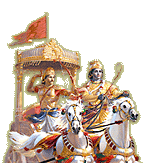
The God Vishnu, incarnated as the charioteer Krishna, explained that Arjuna should do his duty and do battle. Lord Krishna is the teacher of morals to the Arjuna and his brothers, and he encouraged Arjuna to do battle, even against his relatives.
The Bhaghavad Gita is dated between the third century BC and the fourth century AD. (Changes and expansions were made by followers of different philosophies during those years.)